
Interview with Rob Ross, Author of the New Sports Novel, "WonderKid"

First time author, Rob Ross, has managed to weave an epic story of intrigue, adventure and thrills. The main backdrop of this tale is the beautiful game and the name of the book is WonderKid.
Ross's debut novel is not your average run of the mill football story featuring 'last minute winning goals' as a underdog overcomes all; it delves deeper into the darker side of the global game and mixes in a diverse range of fleshed out characters and the human mechanism which make the football industry tick.
Ross was happy to introduce the premise of the book, that from first glance, is a combination of football, drama and crime.
Ross, who is based in North Carolina, elaborated where he got the idea of the story from and the writer who inspired some of his ideas.
"That's a good list, to which I might add travel and food. I was inspired by Peter Temple's Jack Irish book series (and subsequent TV series), in which he successfully blended Australian rules football, horse racing, woodworking, drama and crime together into these richly textured novels.
Reading Temple's work was the first time I thought: Maybe I can combine all the things I'm passionate about into one book. Up until that point, the idea of working on one project for 2+ years was daunting, but the idea of writing about all the things I was passionate about totally changed the proposition of a long project.
The milieu of the book - the atmosphere and the characters - was a world I wanted to hang out in. It was easy to wake up every day, plop down at the desk, and dive in. That said, some of my passions didn't make it through the editing process. Turns out vintage auto repair isn't all that engaging on the page - go figure!
In the era of "Moneyball", his total fascination about football has extended to the technical aspects of the game and also form key parts of the plot.
"In terms of plot, as much as I love soccer on the pitch, I'm even more fascinated by soccer behind the scenes. The idea that data experts, if asked the right questions, can translate the beautiful game into 0s and 1s and create regression models that shine a light on hidden talent or identify tactical advantages is so exciting to me. I can't wait to see how much we learn about the game that can't be seen with the naked eye and watch how smart technical directors and managers apply that knowledge.
I created the character Eli to embody the new generation of analytics experts who are applying their knowledge of statistics, mathematics, economics and computer science to 22 players running around a pitch. When you think about it, it's kind of crazy to expend that kind of brainpower on sports, but it's great for soccer fans."
Football is such a massive money generating industry and like all sectors of society; where there are opportunities, there is also exploitation.
"I've also always been fascinated with the dark side of youth development. Anytime you have an industry where great profits can be made on the backs of children, skeevy people will appear to exploit them. Without giving too much of the plot away, Wonderkid is fundamentally the story of two brothers who have been caught up in a corrupt, exploitative youth development system. Sadly, what happens in my book probably scratches the surface of what goes on in real life.
Just recently, as Major League Baseball negotiated a collective bargaining agreement with the Players' Association, one of the major issues was how to clean up the youth development system in Latin America. Agents and scouts shared stories about exploitative trainers, or buscónes, pumping 10-year-olds with steroids to increase their chances of signing a big-money contract when they turned 16. You know the system must be bad when some of the parties that profit from it are lobbying for change."
Like football itself and in the multipolar world, Ross's novel spans the entire globe and the story is set in many fascinating locations. Ross drew from his own travel experiences and when the world was thrown upside down and travel became a lot more difficult, Ross dug deeper via his own research.
"Definitely. I was familiar with a lot of the locales, like Sonoma, Rome, Lyon, etc. and set a lot of the scenes in specific venues I had visited, but I had to do quite a lot of research for the Brazilian passages, especially those set in the Amazon. Speaking of research, I was about to board a ferry to Corsica in March 2020 to research the area for a few chapters in Wonderkid when the world turned upside down, so unfortunately I never made it there and had to base those chapters on a combination of research and some extrapolation from trips to other Mediterranean islands."
The novel was a first for Ross though writing was something he has always been passionate about from a young age and he hopes to emulate his literary heroes.
"This is the first novel I've completed. I was on the path to be a writer from age seven, when I wrote my first short-story, to age 24, when I finished my MFA. By that time I was burnt out on writing and turned my attention to another career for the next 16 years or so. Then, somewhere around my 40th birthday, I decided that I was ready to return to the desk. These past few years have really been a joy. Obviously, I have much more life experience now to draw from, but also my motivations for writing are completely different than when I was young. I no longer write to dazzle technically or wow anybody with my intellect (not that I ever particularly succeeded in that). My writer heroes now are mostly understated writers like John Williams, Evan S. Connell, and Richard Yates, writers whose greatness lies in getting every line so right, you forget anyone is telling the story."
When Ross made the conscious choice to become 'Disciplined' in order to complete his initial drafts, he created his own rules.
"When I decided to write again, I established the following three rules:
- Have fun! If I find myself not having fun, I move on and write something else. Life's too short.
- Write what you would want to read. I want to be sure I'm satisfying my own aesthetic, not anybody else's, because ultimately, even if my book doesn't sell a ton of copies, at least I will have enjoyed writing it.
- Every day. This speaks more to the power of routine. Writing a novel is a marathon. Sticking to a schedule and maintaining momentum are key to seeing it through.
I could go on and on about what's easy or hard about writing, but I'm not sure it would be helpful to anybody."
"Everyone has to find the process that works for them. I start by jotting down a high-level narrative arc, major plot points, ideas for characters, etc. and then just jump into writing scenes. Scenes will naturally reveal things about the characters or propel the plot in unexpected directions; you don't want to overplan them. For me, the biggest joy of writing - or any creative endeavor - is losing yourself in the work. There are days I come back to myself and reread what I've just written and have absolutely no idea where it came from. It was in my brain somewhere, but it beats me how it got there. Generally, the passages you write when you're in the zone end up being the best because that's when you come closest to describing something as it is rather than how we've all agreed to talk about it."
Like all writers, Ross unleashed his creative juices and racked up a huge word count and like all writers, he had to think of how to cut down the number of words.
"For me, revision is the hardest part of writing. That said, it's the most important. My original manuscript was something like 200K words and I was convinced I needed them all. The final manuscript is 111K words. Initially I thought: Why did I write so much extra stuff that wasn't necessary to moving the plot forward or developing the characters? But then I realized that everything you write gets you to the next thing. It's the connective tissue that leads you to the next scene. Now I don't worry about it. First drafts should be loose and somewhat indulgent. You never know what will survive the revision process, so just keep writing and take comfort knowing that, if it's no good or extraneous, you can scratch it out later. No one will know.
The other thing about revision is that it takes perspective, and perspective takes time. You have to step away from the manuscript and do something else before coming back to it. It can be frustrating if you're impatient like me, but on the bright side, perspective always works. You can think a scene is tight as a drum, but if you walk away from it for two weeks, then come back to it, your eye will immediately spot the bloat and you will have no qualms about cutting it or condensing it. Come back after another two weeks and you'll see things you didn't see the previous time. And so on. I probably revised Wonderkid ten times cover-to-cover, and some scenes were revised up to 50 times. To revise like this and not drive myself crazy, I had to learn to celebrate finding the extra word or unnecessary scene. You can't see it as waste; you have to see it as distillation. If you filter out all the extraneous stuff, the end product will pack an even bigger punch for the reader."
These days, everyone calls themselves a writer and every average Joe would say they are capable of hashing out a new book. With many many sports novels on the market, Ross was happy to discuss what makes Wonderkid stand out and why would readers; not necessarily sports fans, enjoy the book?
"The majority of novels about sports are written by sports enthusiasts who aren't necessarily trained writers. I come at it from the opposite angle, where I'm trained in writing and chose the world of soccer as my setting. Which is to say I hope that the quality of the writing helps Wonderkid stand out. I don't hold myself up as a literary master or anything, especially after such a long layoff, but I have years of training and I've spent all my life studying the best writers on the planet, underlining passages and making annotations. I don't often read for pleasure. Mostly I read to understand what makes a book work or not work. In that way I'm probably like those Analytics experts who don't watch soccer matches to feel emotions, but rather to dissect them, trying to spot hidden correlations."
Interestingly, Ross, who absolutely loves soccer, does not identify with any team. The global game itself and all its intricacies and idiocracies, is enough for him. Football can be a flawed game and yet can present moments of sheer beauty. Ross, with his intricate eye, for detail, always seeks to experience the magical moments that football serves up.
"Believe it or not I am neutral. I have favorite teams in other sports (American Football and Baseball) and while identifying closely with them can stimulate intense emotions when they win or lose, I find it's actually a detriment to seeing the beauty in those sports. When I got hooked on soccer, I consciously decided not to align myself with a team, but instead seek out beautiful soccer wherever I found it."
"I visited the Ajax youth system once with my colleague Julian and we watched the 11-year-old team scrimmaging. A winger was in possession along the touchline and his opposite winger had drifted open. I pointed to the space and told Julian that he ought to switch it. Julian saw the distance, considered their age, and told me, "big ask." But the winger saw it, too, and thumped the ball. It landed at the opposite winger's feet, he one-touched it and was off to the races. I love witnessing vision and skill like that, wherever I find it, which is why I remain neutral. All that said, if pressed, I'd confess that I've always had a soft spot for Porto."
Thank You!
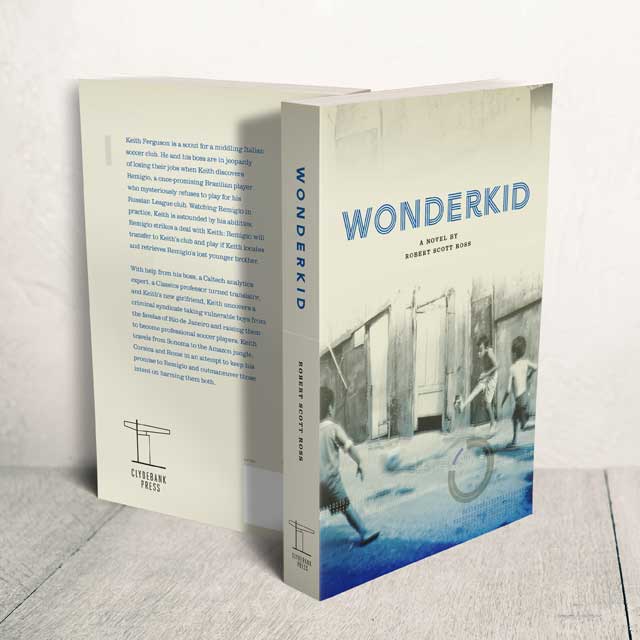
Books Details
Full title: Wonderkid
Author name: Robert Scott Ross
Publisher/Imprint: Clydebank Press
Pub date: 17 May 2022
Page count: 402
Price: £10.99 (paperback); £3.99 (ebook)
ISBN: 9798985057508 (print); 9798985057515 (ebook)
Amazon: Buy this book from Amazon UK
Description (from jacket blurb):
Keith Ferguson is a scout for a middling Italian soccer club. He and his boss are in jeopardy of losing their jobs when Keith discovers Remigio, a once-promising Brazilian player who mysteriously refuses to play for his Russian League club. Watching Remigio in practice, Keith is astounded by his abilities. Remigio strikes a deal with Keith: Remigio will transfer to Keith's club and play if Keith locates and retrieves Remigio's lost younger brother. With help from his boss, a Caltech analytics expert, a Classics professor turned translator, and Keith's new girlfriend, Keith uncovers a criminal syndicate taking vulnerable boys from the favelas of Rio de Janeiro and raising them to become professional soccer players. Keith travels from Sonoma to the Amazon jungle, Corsica and Rome in an attempt to keep his promise to Remigio and outmaneuver those intent on harming them both.
Author Biography:
Robert Scott Ross lives and works in Durham, North Carolina. Wonderkid is his first novel.
Buy tickets for soccer matches around the world