
J-League Season 2014: the J-League returns after World Cup recess
Paul Williams
After a two-month hiatus for the 2014 FIFA World Cup, a tournament most in Japan will be all to happy to forget as quickly as possible, the J.League returns in earnest this weekend.
When games kick off Saturday night it will have been 62 days since the last J.League, so here's a quick recap of the first half of the season.
Kashima Antlers and Yokohama F.Marinos made the early running, before both fell away to sit mid-table, or in Kashima's case just above it. Two-time defending champions Sanfrecce Hiroshima, Vissel Kobe, Sagan Tosu and Urawa Reds have all had spells on top, with the Saitama side topping the table as the J.League headed into its summer recess.
At the other end of the table Tokushima Vortis have failed to make the grade after a fairy tale promotion from J2 last year. Just one win from 14 matches is a poor return in anyone's language. Even at this stage with 20 games still to play they're all but relegated and can start planning for life back in J2.
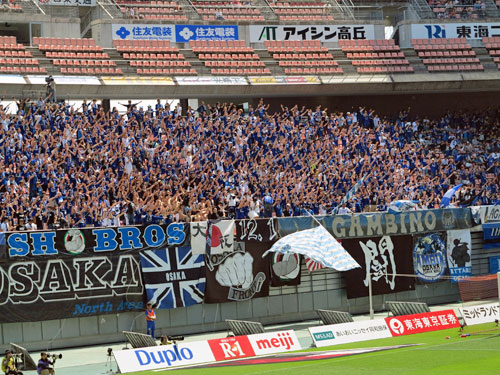
It hasn't quite been the return to J1 that Gamba Osaka would have imagined either. The 2008 AFC Champions League winners swept all before them in J2 last season, but they have struggled on their return and sit just above the relegation zone.
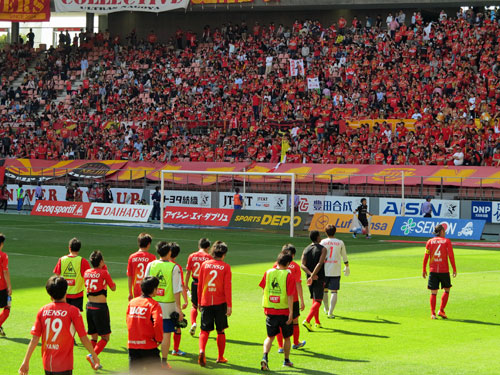
Also on Struggle Street is Nagoya Grampus, now under the guidance of former-Gamba Osaka coach Akira Nishino, and Cerezo Osaka, who were early title favourites after the stunning off-season signing of Diego Forlan. That poor start to the season cost Ranko Popovic his job after just six months in charge, replaced in the two-month recess by German Marco Pezzaiuoli.
His was just one of a number of changes in personnel over the summer.
Genki Haraguchi (Urawa to Hertha Berlin), Junya Tanaka (Kashiwa to Sporting Lisbon) and Yoichiro Kakitani (Cerezo to FC Basel) have all departed for Europe, with Kakitani given an extravagant, some would say over-the-top, send off earlier in the week by Cerezo and their supporters.
While they depart, there has been movement in the other direction. Out of favour Kashiwa attacker Leandro Domingues has joined Nagoya Grampus, a shrewd pick up by the 2010 champions as they look to turnaround their form in the second half of the season.
Yokohama F.Marinos have also strengthened their attack with the acquisition of Rafinha from 2012 Asian champions Ulsan Hyundai, while former Kawasaki and Ventforet Kofu striker Patric has joined Gamba Osaka.

At the other end of the pitch, Italian defender Michele Canini looks set to sign for FC Tokyo.
One move that I am interested in following is that of Hiroshi Ibusuki.
A tall, young striker who looked to be on the verge of a La Liga breakthrough with Sevilla just a few years ago, the 23-year-old has signed with Albirex Niigata. His potential partnership with Kengo Kawamata, who some suggest should have been part of Japan's World Cup squad, on paper looks to be quite dangerous and could propel Niigata up the table in the second half of the season.
For Ibusuki it will also put in front and square in front of the new Japanese national team coach, likely to be Javier Aguirre. With Japan crying out for a #9 who can regularly hit the back of the net, and with the Asian Cup just around the corner, it could be a career-changing move for Ibusuki.
It's now up to him to perform on the pitch.
Speaking of performing, that is what Urawa will need to continue to do if they want to lift the title come December. And history is against them.
Since the J.League went to a single season format in 2005, only twice has the team that topped the table going into the mid-year break gone on to win the title (Kashima in 2009 and Kashiwa in 2011).
The mid-year break didn't exactly come at a good time for them either as they were just building momentum, having won seven of their last nine games and going undefeated in their last five games before the break.
How they cover the loss of Haraguchi, one of, if not their best attacking option in recent seasons, will go a long way to determining their title credentials this season. More will be expected of Shinzo Koroki and Tadanari Lee on the goal scoring front, with just six goals between them in the opening 14 games.
While they easily have the best defence in the league, conceding just nine goals, they are the lowest scorers in the top five and with Haraguchi, their leading scorer with four, now gone it presents a problem for Mihailo Petrovic. Just where will the goals come from?
That is just one of many questions that will be asked and answered over the coming weeks.
For now, it's just good to have the J.League back.
Copyright: Paul Williams & Soccerphile.com
Keep up with all the soccer news from Japan as well as the Japan national team, Japanese players overseas and the Asian Cup.
More J-League Soccer News - previous articles from the J-League
Buy tickets for soccer matches around the world