
UK Stadiums: Loftus Road, West London, England
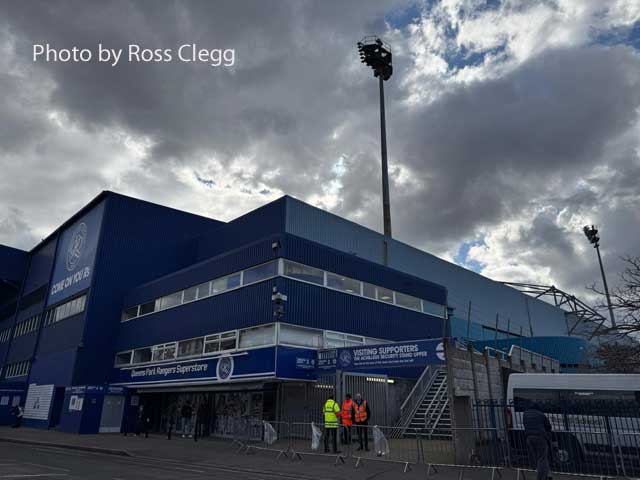
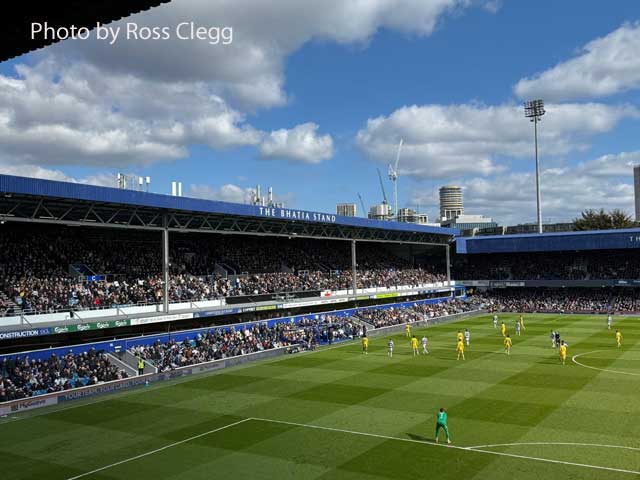
Loftus Road, currently named MATRADE Loftus Road Stadium for sponsorship reasons, in Shepherd's Bush, London, England, is an all-seater stadium with a capacity of 18,439. It is the home of Queens Park Rangers Football Club (QPR). It has been the venue for QPR games since 1917, except for two spells.
Those two spells were spent at White City Stadium, a venue demolished in 1985. QPR played at the 93,000-capacity stadium between 1931 and 1933 and from 1962 to 1963. Its most notable role was hosting the 1908 Summer Olympics, but it also served as a venue during the 1966 FIFA World Cup, staging a single match between Uruguay and France, which drew a crowd of 45,662. There were talks of QPR moving to the mega arena permanently, but the club decided to stay put at Loftus Road.
Loftus Road made headlines in 1981 when it installed Omniturf, a type of artificial turf. In 1988, QPR reverted to natural grass.

Sharing
The ground has a history of sharing with other teams, some of them outside of football. From 1996, the rugby union team London Wasps called Loftus Road their temporary home for six years before relocating to Adams Park, the home venue of Wycombe Wanderers. When Craven Cottage was closed for reconstruction between 2002 and 2004, Fulham used the stadium. During the 2020-21 season, AFC Wimbledon played their home games here while the new Plough Lane stadium was completed.
The stadium took on a different name for the first time in 2019, as it was named the Kiyan Prince Foundation Stadium for three years. Kiyan Prince was a former youth team player who was tragically stabbed by a fellow 16-year-old in Edgware.
QPR have earned many nicknames over the years, including The Rs, Rangers and The Hoops.
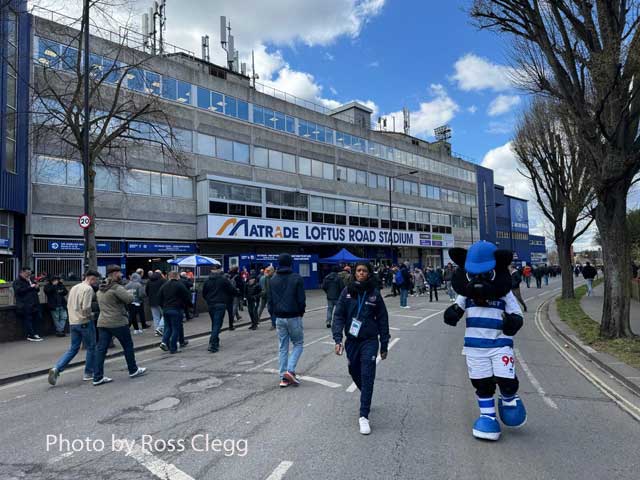
Stadium Stands
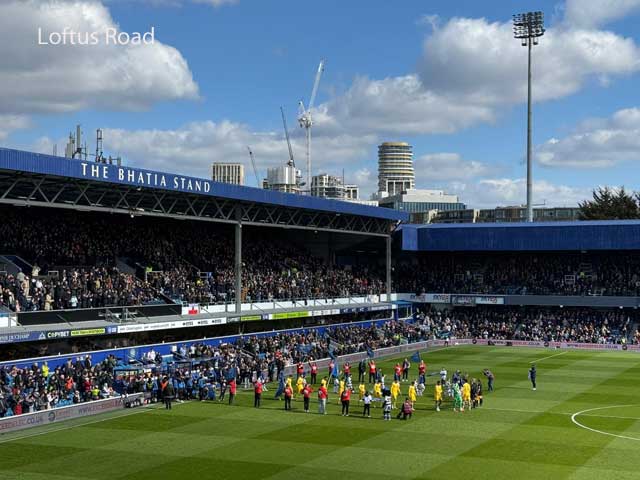
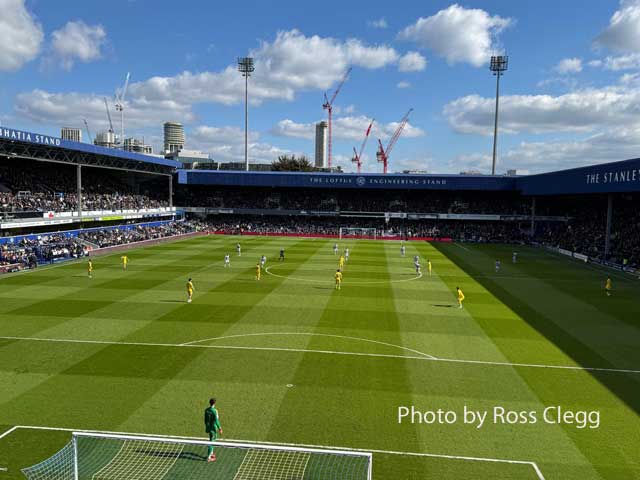
The four stands are the Loftus Engineering Stand (often shortened to The Loft), The Stanley Bowles Stand, The Bhatia Stand and the Achilleus Security Stand.
The Loftus Engineering Stand is a two-tier construction. This is the end QPR typically aim to attack in the second half, as it's believed to bring good luck. The Blue and White Bar is located here. A new colour scoreboard was installed in 2008.
The Ellerslie Road stand was renamed The Stanley Bowles Stand. It is a single-tiered stand but is not the smallest in capacity. R Block contains 237 rail seats, providing the option to stand for the full ninety minutes. The commentary and television camera gantry are placed here. It is the only stand that is not coloured in blue and white hoops.
The Bhatia Stand - formerly the South Africa Road Stand - is the largest and perhaps the most prominent of the four. It contains facilities including the dugouts, dressing rooms, and the club shop, officially titled the "Queens Park Rangers Superstore." For those seeking a premium matchday experience, this stand offers hospitality through the W12 and C Clubs.
The Achilleus Security Stand is at the western end. It is where away supporters are housed on matchdays.
Non-QPR Football Matches
Possibly due to its favourable location, Loftus Road has been the venue for multiple international friendlies. Australia has familiarised itself with the ground over the years, using the ground on three occasions between 2006 and 2008. The Socceroos are yet to secure a win, losing once and drawing twice.
In 2015, a Saudi Super Cup tie between Al Hilal and Al Nassr took place in front of 8,439 spectators. It was the first time the competition was staged outside of Saudi Arabian borders.
Stadium Miscellaneous
On 2 September 2017, to raise money for those affected by the Grenfell Tower fire, Team Ferdinand took on Team Shearer in a charity match named Game 4 Grenfell. Grenfell Tower was located a mile away from Loftus Road. The game was played by a mixture of ex-professionals and celebrities, with Team Ferdinand containing Olly Murs and Sir Mo Farah. The game ended 2-2, Team Ferdinand winning 5-3 on penalties.
Early Club History
QPR's history begins when St Jude's merged with Christchurch Rangers in 1886. That said, QPR trace their roots back to 1882, when Christchurch Rangers were established. The name came to be because the club recruited schoolboys from the area of Queen's Park in North-West London. They participated in the amateur football movement and showed their proud origins in 2011 when club icon Stan Bowles unveiled a plaque celebrating its history.
The club was elected into the Southern Football League in 1899, making them a professional outfit.
At this time, the core of the support came from the former Boroughs of Paddington and Willesden. As London grew in size, so did the support for QPR.
As winners of the 1907-08 Southern Football League, QPR qualified for the first Charity Shield, pitting their wits against Manchester United. United won out after a reply, both being held at Stamford Bridge.
The Hoops bounced around many different arenas, but finally settled at Loftus Road in 1917.

Post-World War II
QPR reached the second tier for the first time in 1948-49 thanks to a successful campaign the season prior. Led by Dave Mangnall, QPR also enjoyed a cup run in 1947-48 alongside the championship title but were eliminated in the quarter-final stage, losing to Derby County 0-5 at the Baseball Ground.
In June 1950, defender Tony Ingham signed from Leeds United. He would become the club's all-time top appearance maker.
Before the start of 1959-60, QPR appointed Alec Stock, who is seen as one of the greatest managers to lead the side. Along with chairman Jim Gregory, QPR modernized and enjoyed a seismic shift in the atmosphere.
1966-67 was wildly successful. QPR romped to a Division Three championship, losing one home match all season and claiming the title twelve points ahead of their nearest challengers, Middlesbrough. But what was more remarkable was their League Cup run. After a 7-2 aggregate demolition of second-division Birmingham City in the semi-finals, QPR played another Midlands team, West Bromwich Albion in the final at Wembley Stadium.
West Brom were the defending champions, having beaten West Ham 5-3 on aggregate the season before. The Baggies had Jeff Astle in their ranks, an all-time WBA great. The first single-legged match in League Cup final history started brilliantly for WBA, racing into a 2-0 lead before half-time. But Clive Clark's brace did not faze QPR, with Roger Morgan and Rodney Marsh stepping up to level the tie. With nine minutes remaining, QPR did the unthinkable thanks to Mark Lazarus' tap-in, ensuring a third-tier side overcoming a top-flight opponent. It remains QPR's sole major cup trophy.

QPR at its Peak
In 1972-73, QPR attained top-tier status for the second time in their history under the shrewd management of Gordon Jago. It was the start of a golden era, a form the club have yet to replicate. QPR boasted quality all over the pitch, including Phil Parkes, Gerry Francis and Terry Venables. But the crème de la crème of the side was Stan Bowles. Bowles signed at the start of that season, having developed through the ranks of his hometown club, Manchester City. But Man City had a stellar squad at the time and was kept out of the team by Francis Lee. He butted heads with coach Malcolm Allison, and it became clear he had to find alternatives to resuscitate his career. He traversed through Northern clubs with brief spells at Bury, Crewe Alexandra and Carlisle United. Bowles was signed as a replacement for Marsh, who ironically left for Man City.
Bowles was a key figure in QPR's greatest league campaign of 1975-76. Managed by Dave Sexton, QPR were quietly enjoying a splendid season, but their title chances took a hit when they lost three out of four in the Christmas period. Still, after recording an extraordinary run of eleven wins out of twelve, hopes were high heading into a game at Carrow Road, with three matches remaining. Mid-table Norwich City derailed their plans by winning 3-2, handing Liverpool the initiative. As QPR and Liverpool won their penultimate fixtures, the title headed to Merseyside. Although the season ended agonizingly, supporters remember this campaign fondly.
Their heroics in 1975-76 allowed QPR to embark on an unforgettable UEFA Cup journey. After brushing aside Brann Bergen (SK Brann) and Slovan Bratislava, they faced the might of 1. FC Köln. Containing some superstars in Toni Schumacher, Dieter Müller and Preben Elkjaer, Köln looked like tricky opposition. QPR were in cruise control after winning 3-0 at home in the first leg, but The Billy Goats made them sweat in the return fixture, hauling themselves off the canvas by equalizing to make it 4-4 on aggregate.
Despite going down to ten men in the first half, Don Masson's early goal at the Müngersdorfer Stadion (RheinEnergieStadion) was just about enough to squeeze QPR through. Sadly, the road terminated at the quarter-final stage, losing to AEK Athens. As in the Köln match, QPR secured a 3-0 home win, with Francis netting a brace this time. In the second leg at Stadio Nikos Goumas, AEK remarkably levelled the tie when Mimis Papaioannou bagged his third tournament goal eight minutes from time. The proceeding penalty shootout dragged on to become a marathon. David Webb's miss meant AEK confirmed progression after sixteen spot kicks were taken. AEK were dumped out in the following stage by eventual winners Juventus.
Prior to the 1977-78 season, Sexton - the mastermind behind QPR's golden era - was enticed away by Manchester United. He was replaced by Frank Sibley. QPR gradually lost competitiveness and were demoted in 1978-79, managed by Steve Burtenshaw. To ensure the rebuild was in steady hands, chairman Jim Gregory appointed Terry Venables, who jumped ship following deepening financial difficulties at Crystal Palace.

Terry Venables
QPR became a force to be reckoned with after Venables joined. Although the club were a second-tier side, QPR reached the FA Cup final in 1982 after eliminating top-flight West Brom at Highbury in the semis, courtesy of a solitary Clive Allen goal. The Hoops faced Tottenham Hotspur in the final, with both sides wearing their away kits. The scores were deadlocked at full-time, only for Glenn Hoddle to break it in the 110th minute for Spurs. Five minutes later, Terry Fenwick equalized and made sure QPR gave themselves a chance through a reply. Co-incidently, Hoddle and Fenwick were England teammates in the 1986 FIFA World Cup held in Mexico.
The reply took place five days after the initial match. The injury to Clive Allen meant Gary Micklewhite came in his place. In truth, QPR found it difficult to contain Hoddle throughout the two games, and the West Londoners conceded an early penalty when Tony Currie brought down Graham Roberts. Hoddle converted the spot kick stylishly. The match ended in a 0-1 loss. This appearance in the final has been the furthest the club has progressed in the competition.
Venables achieved the rebuild by winning the Second Division in 1982-83. Venables' stock grew immensely the following campaign by leading the club to fifth in the First Division. QPR were not blessed with major talent frankly speaking, but with full-back Terry Fenwick producing an incredible ten league goals, the Loftus Road outfit overachieved. These events piqued the interest of FC Barcelona, as the Catalan giants made Venables an offer he couldn't refuse.
QPR established themselves as a solid first-tier club after that. Their best campaign between post-Venables and Premier League was in 1987-88, where they managed a respectable fifth. Their entry to the UEFA Cup was denied due to the bans imposed on English clubs following the Heysel Stadium disaster of 1985. In 1989-90, The Hoops achieved a quarter-final FA Cup exit after Peter Beardsley's goal for Liverpool secured victory at Anfield.

The Familiar Face of Francis
Ahead of 1991-92, the club appointed Gerry Francis from Bristol Rovers, a legendary figure at Loftus Road during his playing days. He had been proving himself an effective manager leading The Pirates in the South West of England. The season was forever immortalized when they demolished Manchester United at Old Trafford, broadcast live on terrestrial television on New Year's Day 1992. Striker Dennis Bailey recorded an unthinkable hattrick.
Their results that season meant QPR were to be one of the original sides of the first Premier League season. Les Ferdinand was terrific in front of goal, bagging 24 goals in all competitions. In a season packed with dark horses, QPR ended in fifth, ahead of Arsenal and Liverpool. It meant they finished the season as the best team in London.
But their time in the sun did not last long, as under the leadership of Ray Wilkins, relegation beckoned in 1995-96. Following the sale of Ferdinand, Danny Dichio shouldered the attacking responsibility, and though his tally of ten league goals was commendable, the club concluded the campaign second bottom.
QPR were relegated to the third tier (Division 2) in 2000-01 but returned to the Championship following promotion in 2003-04.

Neil Warnock the Magic Man
QPR commenced 2010-11 with Neil Warnock in charge. Warnock, who had been in charge since March 2010, made Moroccan maverick Adel Taarabt captain and made him know he would be the talisman no matter what. This risky move to give an inconsistent player freedom paid dividends, as Taarabt tore up the league.
QPR started the season on fire, winning eight of their first ten matches. Except for two matchdays, QPR sat top of the standings, winning the Championship title deservedly. QPR secured the trophy on the penultimate matchday, overcoming Watford 2-0 at Vicarage Road. Arguably the club's toughest challenge came off the pitch when they were investigated for irregularities when signing Argentinian midfielder Alejandro Faurlín from Instituto. Points deduction was a possibility, potentially jeopardizing their promotion. On 7 May 2011, the authorities demanded QPR to pay a fine of £875,000 but did not hand out a points deduction.
2011-12
Ahead of the 2011-12 Premier League campaign, QPR struggled to attract high-calibre players, with DJ Campbell's £1.25 million move from Blackpool standing as their only paid transfer. But that was before 18 August 2011, when Malaysian entrepreneur Tony Fernandes became majority shareholder following the purchase of Bernie Ecclestone's 66% stake.
Although he had declared his love for West Ham United on numerous occasions, Fernandes turned his attention to Shepherd's Bush as co-owners David Sullivan and David Gold were uncompromising in their unwillingness to sell The Hammers. With two weeks remaining in the summer transfer window, QPR acted fast and bought many, including Anton Ferdinand and Shaun Wright-Phillips, but it was Joey Barton's move that caught the eye. Barton joined on a free, and it was reported that he instantly became the best-paid player in QPR history, earning £80,000 a week.
QPR had started the campaign terribly, losing to Bolton Wanderers 0-4. Two days after the' acquisition, QPR got their first win with a 1-0 victory over Everton at Goodison Park. Teenager Ross Barkley was a bright spark in an otherwise dour performance from Everton. Neil Warnock was relieved of his duties in early January, QPR placing one spot above the relegation zone. Mark Hughes came through the door, and his squad was given a boost with three expensive signings at the end of the winter window. Bobby Zamora, Djibril Cisse and Nedum Onuoha each cost £4 million or more.
The second half of the season was not plain sailing for the club, but they were in an advantageous place entering the final day knowing a draw would be enough to clinch survival at Bolton Wanderers' expense. Bolton headed to the Britannia Stadium to play Stoke City while Manchester City entertained QPR. City, who needed to equal Man United's record at the Stadium of Light to win the Premier League, were in the lead at half-time thanks to a Pablo Zabaleta effort.
There was a twist early in the second half when Djibril Cisse pounced on a Joleon Lescott error and equalized. Seven minutes later, Joey Barton figuratively lost his head and was shown a red card for elbowing Carlos Tevez. Barton lashed out further as he kneed Sergio Aguero from behind and had to be manhandled by Micah Richards to take him away from the melee. Things only got weirder, Jamie Mackie meeting an Armand Traoré cross, and QPR were spoiling Man City's big day.
The Citizens grew desperate, fully aware that with Manchester United holding onto Wayne Rooney's early goal, they would need to score twice in stoppage time to turn the tide. Edin Dzeko first equalized, and then came the most famous Premier League moment, the staggering Aguero winner in the 94th minute. The assist for that goal was provided by Mario Balotelli, the only time he set up someone in his Man City career. QPR were safe despite the loss, as Bolton could only muster a 2-2 draw.
2012-13
The 2012-13 season got off to the worst possible start, as Swansea's new signing Michu announced himself on the Premier League stage at Loftus Road by scoring twice in a 5-0 hammering. Having acquired eleven players during the summer transfer window, it was evident that manager Mark Hughes needed time to gel the squad into a cohesive unit. Some new faces that joined include José Bosingwa, who won the UEFA Champions League with Chelsea the season before, Julio Cesar and Park Ji-sung. Most of their signings were free, with Esteban Granero being the most costly, setting QPR back £9M.
After failing to secure a win in his first twelve matches, Hughes was dismissed and replaced by Harry Redknapp. Redknapp was embroiled in a saga a few months before, where rumours of him becoming the next England manager never dissipated while in charge of Tottenham Hotspur in the previous campaign. The FA chose Roy Hodgson instead. QPR's fortunes did not change instantly but did record their first league win on matchday 17 against Fulham at home. Adel Taarabt, who would depart for Fulham on loan the following season, stole the spotlight with a match-winning brace.
The Hoops made two marquee signings in the window, bagging Loic Remy from Marseille and Christopher Samba from Anzhi Makhachkala, who folded in 2022. Remy added sharpness to the QPR attack, ending the campaign as club top scorer with six goals. QPR would record a measly four league wins all season, finishing dead last and 14 points adrift from safety. It was quite frankly an embarrassing showing considering Borussia Dortmund, who had a smaller wage bill than The Rs that season, reached the Champions League final.
2013-14
For the 2013-14 Football League Championship season, Redknapp took a back-to-basics approach, bringing in Danny Simpson, Richard Dunne, and Gary O'Neil - all on free transfers. The signing of Charlie Austin on an undisclosed fee would be a shrewd pickup. QPR were hot favourites to storm the league, but it soon became obvious that the Nigel Pearson-led Leicester City would claim the title. The Foxes laid down a marker in their 1-0 victory at Loftus Road in December, with Jamie Vardy being a nuisance on the counter throughout the afternoon. That was only QPR's third defeat of the campaign, but their promotion hopes looked in jeopardy when they lost three consecutive matches in February. By the conclusion of the regular season, QPR were happy to be in the playoffs.
Their first test in the playoffs was against Wigan Athletic at the DW Stadium. It finished 0-0 in what was a cagey affair. Wigan led the return leg early when right-back James Perch met a cross from Republic of Ireland winger James McClean. Wigan manager Uwe Rösler had to deal with two players limping off through injury, one for James McArthur in the first half and Gary Caldwell, who came off a minute after Charlie Austin equalized for The Hoops. Austin capitalized on some hesitant Wigan defending in extra time, reacting quickest to prod the ball into the net in the 96th minute.
QPR's opponent in the final at Wembley Stadium was Steve McClaren's Derby County, who dominated the proceedings. Will Hughes controlled the tempo, while Jamie Ward and Johnny Russell provided danger and width. But, Rob Green proved to be a reliable presence in a resolute QPR defence. Their job only got more awkward when Gary O'Neil was shown a straight red card for a professional foul with half an hour remaining. The occasion will be remembered for one moment of glory though, as Bobby Zamora made Richard Keogh pay for his error in the penalty box. The goal sealed promotion at the first attempt.
2014-15
To compete for the 2014-15 Premier League season, Redknapp made seven signings. Steven Caulker and Leroy Fer were each signed for £8 million, but the most high-profile addition was Rio Ferdinand, who joined on a free transfer. Niko Kranjčar was another Redknapp signing, joining on loan from Dynamo Kyiv, having previously worked with Harry at both Portsmouth and Tottenham.
QPR were sitting in 15th place after seventeen games when they claimed their fifth league win against West Bromwich Albion, already surpassing the record of 2012-13. However, their fragile defence began to show deeper flaws, managing only two clean sheets after the New Year. Redknapp was let go in favour of Chris Ramsey in February. Because of Charlie Austin's inspired form, there was some firepower going forward but the top flight proved too difficult again for Rangers. QPR concluded the season with a 1-5 drubbing at the hands of Leicester at the King Power Stadium. Esteban Cambiasso rolled back the years, putting his name on the scoresheet in the second half.
2015-16 to the Present Day
2015-16 was a reality check. Although the two sides relegated alongside The Rs achieved immediate promotion, QPR were placed 12th, slap bang in the middle of the standings. Lured by the offer from an upwardly mobile Southampton, Austin left for the South Coast. He joined an exciting attack, supplementing Sadio Mane and Graziano Pellè. It was a season of few promises, except for perhaps the emergence of attacking midfielder Tjaronn Chery. Jimmy Floyd Hasselbaink took the reins in December 2015.
Hasselbaink lasted eleven months, bringing old favourite Ian Holloway back on 11 November 2016. Holloway prioritized giving youth its chance, allowing talent such as Ilias Chair and Eberechi Eze to blossom. With QPR languishing 16th at the end of 2017-18, Holloway departed.
Nowadays, QPR enjoy stronger Asian representation, with Koki Saito from Japan - who spent two solid seasons in the Eredivisie with Sparta Rotterdam - joining the squad ahead of the 2024-25 season. Exciting young winger Yang Min-hyeok, already capped for Korea Republic at age 18, joined in January 2025 on loan from Tottenham to boost the frontline. Yang is not the first South Korean to feature for Rangers; left-back Yun Suk-young made 37 appearances during the mid-2010s, while Park Ji-sung was once briefly on the books from 2012-2014.
Club Icons (Marsh & Ferdinand)
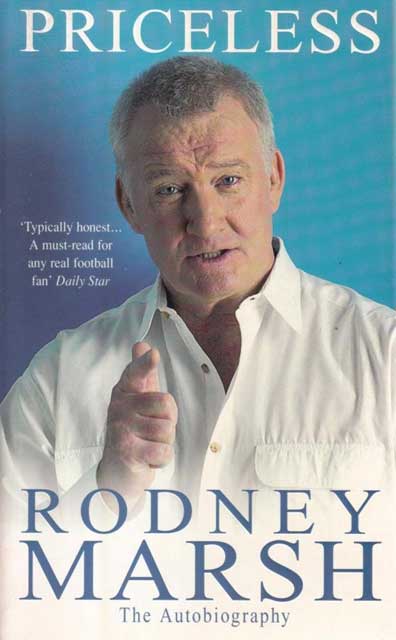
Rodney Marsh grew up in the East End under difficult circumstances. He revealed in his 2001 autobiography Priceless that his father was crippled at age 19 due to Rodney's grandfather attacking him. The family struggled with destitution, sleeping in the corner of his parents' until salvation came through football. Marsh was scouted by West Ham United. He made his professional debut with Fulham in March 1963.
While at Craven Cottage, Marsh's career was on the cusp of early devastation when he collided with Leicester's John Sjoberg in September 1963. He lost his hearing in his left ear and was unable to keep his balance while standing for weeks.
Marsh clashed with Vic Buckingham, credited as the pioneer of Total Football. Buckingham, one of three English managers to have taken the reins at FC Barcelona post-World War II, sold Marsh to QPR.
QPR saw the best of Marsh in his first full season, 1966-67. He scored his first hattrick against Middlesbrough in a 4-0 thrashing. QPR managed a shock League Cup win by overcoming West Brom in the final with Marsh in the team.
Marsh went through ignominy when he retaliated to Kai Johansen's provocation against Glasgow Rangers in a friendly in the summer of 1969 and saw a straight red card.
Manchester City strengthened their frontline in 1972 by signing Marsh for a then-club record £200,000. In 1974, a Manchester City team featuring Denis Law, Colin Bell, and Mike Summerbee had the opportunity to claim a second League Cup title. But their hopes were dashed by goals from Kenny Hibbitt and John Richards in the final against Wolverhampton Wanderers.
After his spell in Manchester, he moved to the North American Soccer League and Tampa Bay Rowdies, where he was prolific.

Les Ferdinand was cultivated in the harsh landscape of non-league football, where he was on the books of Southall FC and Hayes FC. QPR took a punt by paying Hayes £50,000 to acquire his services. To give Ferdinand vital experience, QPR loaned him to Brentford and Besiktas. Ferdinand took to Turkish football like a duck to water and became an integral part of QPR when he returned. He scored 10 league goals in 23 outings in 1991-92, ensuring QPR would be part of the original members of the rebranded Premier League. From this point forward, Ferdinand became a constant threat to top-flight defences, netting 20 league goals during the 1992-93 season. QPR finished the season in fifth place, making them the highest-ranked team in London.
An ambitious Newcastle United snapped up Ferdinand for £6 million in 1995, with Hayes receiving £600,000 due to a sell-on clause. Hayes built a function suite named "The Ferdinand Suite" with the money they received.
Other players remembered with affection by QPR fans include right back Dave Clement who made a total of 472 first team appearances during his fourteen year career at the club in the 1960s and 70s. He tragically committed suicide, aged only 34 in 1982. His eldest son Paul Clement worked with Carlo Ancelotti at Chelsea, PSG, Real Madrid and Bayern Munich, and also managed at Swansea City, Reading and Derby County.
Clive Allen scored 62 goals during two spells at the club and also played for several other London clubs: Arsenal, Chelsea, Crystal Palace, Spurs, Millwall and West Ham. Winger Dave Thomas is another 1970s Hoops legend with 27 goals in over 170 appearances. Thomas also represented England during his time at the club. Goalkeeper Phil Parkes played 334 games for both QPR and West Ham.
Trevor Sinclair first made his name at Blackpool before a big money move to QPR in 1993. He played over 160 games for the club before a move to West Ham and went on to represent England at the 2002 World Cup in Korea/Japan.
Club Miscellaneous
While QPR face competition from Fulham and Chelsea for local support, they have supporters' clubs in countries such as the United States, Australia, and Sierra Leone. Their most recognizable fanzine is A Kick Up The R's, which has been in circulation since August 1987.
QPR have an impressive collection of celebrity supporters, including comedian Bill Bailey and filmmaker Louis Theroux, who revealed his love for The Hoops in Vogue magazine. British political heavyweight Michael Gove is also a supporter.
Major Honours
League:
First Division / Premier League (level 1)
・Runners-up: 1975-76
Second Division / First Division / Championship (level 2)
・Champions: 1982-83, 2010-11
・2nd place promotion: 1967-68, 1972-73
・Play-off winners: 2014
Third Division / League One (level 3)
・Champions: 1947-48, 1966-67
・2nd place promotion: 2003-04
Cup:
FA Cup
・Runners-up: 1981-82
Football League Cup
・Winners: 1966-67
・Runners-up: 1985-86
Accessibility
Wheelchair-accessible spaces for home supporters are provided in Block AL of the West Paddock, Block GL of the East Paddock, and Block X in the Stanley Bowles Stand. Wheelchair users can watch games at a discount and bring a companion free of charge. To qualify for the discounted disabled concession, the QPR Box Office requires supporting documentation, which must be submitted annually.
Visually impaired supporters can access match commentary by visiting the Alton House entrance on South Africa Road. Please email (operations@qpr.co.uk) or (supporterservices@qpr.co.uk) to organise this service.
Guide dogs are allowed at Loftus Road, but QPR would appreciate being notified of their presence before entering the stands. Once again, please contact (operations@qpr.co.uk) or (supporterservices@qpr.co.uk) to receive adequate care for the guide dogs.
The sensory room is situated in the Family Stand.
Access - Getting There
The official website of QPR discourages supporters from using motorcars due to its location.
The nearest tube station is White City on the Central line, which takes roughly five to ten minutes on foot to get to the stadium. Wood Lane Station, on the Hammersmith & City Line, is another viable option. It is approximately a seven-minute walk to Loftus Road from here.
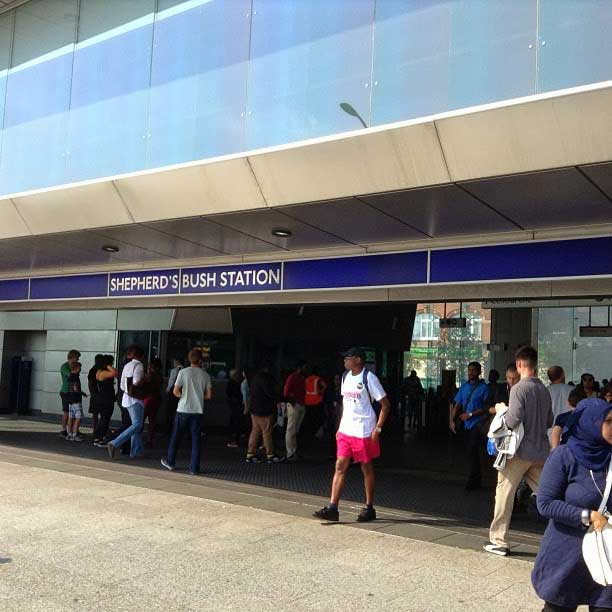
Fans arriving via the Overground should get off at Shepherd's Bush, located next to the Underground station. This station is useful for visitors coming from Watford Junction and Clapham Junction.
For bus services, look out for 283 to Bloemfontein Road and 72, 95 or 220 to White City Station.
Address: South Africa Road, London W12 7PJ
Nearby Hotels
If you wish to stay in this part of London there are several options. The four-star Hilton London Kensington is the standout, just 300 meters from the station. Also, close by are the Dorsett Shepherds Bush London and the K West Hotel & Spa.
See here for a complete listing of hotel accommodation in London.
More UK Stadiums
Kirklees Stadium (John Smith's Stadium)
©Soccerphile.com
Buy tickets for soccer matches around the world