
England's Calamity? A New Interpretation of the 'Match of the Century'
Sean O'Conor
Calamity (noun) - 'a disastrous event marked by great loss and lasting distress'
- Merriam Webster's Dictionary of English
"If we want everything to stay the same, then everything has to change."
- Giuseppe Tommasi di Lampedusa, The Leopard
In the Ferencváros neighbourhood of Budapest, on the east bank of the mighty river Danube, sits a borozó - a wine bar, with a name which should ring resounding historical bells for football supporters - 6-3.
For that was the score with which Hungary embarrassed England at Wembley in 1953, the first time the first football nation had lost at home to anyone from beyond the British Isles.
As the Aranycsapat (golden team) took their hosts apart that crisp November afternoon, the 105,000 present witnessed a landmark in football history - a sorry confirmation that the inventors were no longer masters of their own game, a bona fide end of an era.
That match was one of a triptych of blows to England's national identity in the decade following the Second World War, which were grey years of austerity anyway for a weary population who still needed ration books to buy their food.
Three years after England's shock loss to the USA in their first World Cup finals game and three years before the Suez Crisis rubber-stamped Britain's loss of global power, the devastating judgement issued by the Mighty Magyars pinpointed the storied soccer nation's fall from its pedestal of prestige: No more could the Three Lions claim to be the undisputed kings of football.
But it was also an essential cry for the motherland to wake up, smell the continental coffee and reinvent itself as a football nation, a counterrevolution which would bear fruit on the same pitch in 1966.
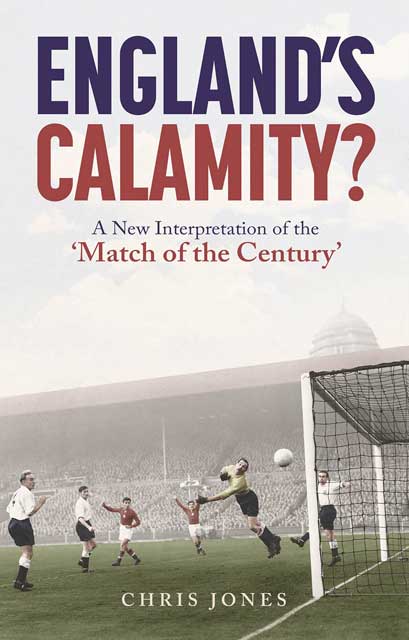
These themes are all addressed in Chris Jones' England's Calamity? A New Interpretation of the 'Match of the Century', published by Pitch.
There is no end of books about England's greatest victory, the 1966 World Cup final, but reflections on the Three Lions' nadir are confined to articles and chapters in wider histories. Since memory is selective and leans towards smiles over sadness, that is no surprise, but the 1953 match is just as significant in a wider context.
Jones has done a lot of research, combing the player autobiographies and 1950s soccer annuals, as well as the contemporary newspapers and minutes of the Football Association to create a complete picture of the earthquake as it happened.
The book is divided into three parts - before, during and after the 90 minutes, and begins with an analogy with 371 B.C., when the hitherto unvanquished Spartans lost the Battle of Leuctra to the Thebans, who had prepared an innovative formation and new tactics.
What stands out is how breathtakingly amateur The Three Lions were in 1953 when judged by today's standards. Indeed, the whole set-up relied on the head start England enjoyed with organised football, an advantage that had bred a complacency they had wallowed in for years, carrying on blissfully unaware the sport was advancing professionally in other countries.
In 1953, continental Europe was psychologically much further than the 21 miles of sea between England and France. Unless they had served in the forces, most Brits had not even been to Europe as almost everyone holidayed at home.
The only contact most fans and journalists had with football outre-manche was when a European team came to play at Wembley and since the Three Lions had never lost to one in their fortress, there seemed no need to worry about the Hungarians.
There was simply no common knowledge about overseas football then like there is now. There were no European club competitions and with no England in a European World Cup until 1954 and no European Championship until 1960, the annual British Championship was the main concern in international football.
While domestic sporting attendances were huge, it was in Jones' words, "An intra-island experience. British competitors at British venues, watched by British crowds live and absorbed through British media by millions of Britons."
Fans in England were vaguely aware Hungary had been making waves, bagging the 1952 Olympic title and hammering continental opposition in friendlies, but precious few had seen them in the flesh or on TV. England's outside left George Robb was one, having watched Hungary at the 1952 Olympics and manager Walter Winterbottom had travelled to Budapest ten days before the Match of the Century to see them play Sweden.
Hungary had an off day then, drawing 2-2 and had almost lost it when Sweden's Kurt Hamrin hit the woodwork in the final minute. On the evidence of that match and a narrow 3-2 win over Austria earlier that month, Winterbottom wrongly reckoned his side would have enough to deal with the Magyars at home.
It did not take long for England's confidence to unravel and their maiden home record to be sullied - Hungary found the net within 45 seconds and by 27 minutes they had raced into a 4-1 lead. The Magyars' fluid 3-2-3-2 formation bamboozled England's static W-M shape, leaving the white shirts chasing shadows.
Nándor Hidegkuti's 'deep-lying centre-forward' position led England's markers on a merry dance as he scored a hat-trick, effectively marking the birth of the false nine position. Captain Ferenc Puskás meanwhile, bossed the attack and bagged a brace, their other coming from Jószef Bozsik. 6-3 flattered them by most accounts as they eased off in the second half.
Winterbottom, overall a deep-thinking and coach open to new ideas, failed to alter England's shape or tactics at half-time and apparently spent most of it talking to Robb.
Sweden's English manager George Raynor had warned him in Budapest that man-marking Hidegkuti was the key to stopping Hungary but Winterbottom failed to heed his advice, instead concluding that Sweden's massing in their defensive third was the reason they had avoided defeat.
But it was unrealistic to expect unconquered England to adopt a catenaccio ploy in front of their own fans. As Hungary attacked, England did draw back but that gave Hungary's mobile midfielders, especially Hidegkuti, space in which to roam. When England went upfield again and lost the ball, they were quickly picked off by fast interchanges.
The Hungarians had a well-honed game so their players did not stop and think before passing. An observer noted they always had two or three options for distribution because their teammates had already scurried into receiving positions.
England's off the ball running by comparison was largely limited to one passing option and they relied too heavily on letting the fleet-footed Blackpool duo of Stanley Matthews and Stan Mortensen work their own magic.
In the end there really was no contest as the red shirts' passing and thinking was much faster than England's and their rotating midfield, based on Austria's The Whirl, the precursor of the Dutch Total Football of the Seventies, caused their rigid opponents no end of headaches.
England were left dazed and although scoring three at home was proof of their own attacking potency, conceding six was equally proof of an outmanoeuvred midfield and a shredded defence.
And so to the English post-mortem, for which everyone had their tuppence ha'penny worth. Once the dust of the shock result had settled, some watchers were frank about England's shortcomings, while others got defensive and dissembled.
Goalkeeper Gill Merrick brought the Football Association a list of his recommendations on aping the Hungarians, beginning with identifying good youngsters and schooling them in the same playing style, while England needed to keep the ball on the ground, be more mobile and stop playing in predictable lines. He also complained that Hungary's players were much better paid. It was the age of the maximum wage in Britain after all.
Alf Ramsey, who never played for England again, showed his frequently stubborn side by blaming Merrick for not saving what he saw as long-range flukes and opined that a better team selection would have prevailed, a perennial get-out-of-jail-free card after defeats.
Centre half Harry Johnston oddly claimed the Hungarians were no revolutionaries but had merely revived the old English short passing game (which began in Scotland). Doubling down on denial, he claimed that England's players were more technical than Hungary's.
Laughably, he said that Puskás, a Real Madrid legend revered as one of the greatest of all time and after whom FIFA's named their award for the best goal of the year, was "just another good inside-forward who showed the fans nothing new", and not a patch on Sunderland's Len Shackleton or Doncaster's Peter Doherty.
He did however, correctly identify his opponents' off the ball running as superior to England's and dismissed the long-ball game played by some clubs at home as "spiv soccer".
Matthews, however devastating he was on the wing, comes across as blinkered in blaming team selection and urging a return to traditional English football, whatever that was.
Journalists were more forthright, compiling a list of English inadequacies which sound familiar every time the national team is beaten: Poor technique, tactical stubbornness, an obsolete formation, bad team selection, a preference for individualism over the collective, no long-term strategy and a lack of preparation time due to club demands etc. Twas ever thus.
Telepathic teamwork gave the Hungarians a clear edge, a unity of thinking forged over years of playing together, but the visitors' formation was superior too, as were individual players' techniques.
There really should have been a pre-mortem as before a ball was even kicked the Magyars were a class apart and the Three Lions had deep flaws in their set-up. As in 1950, the players were still not being picked by manager Winterbottom but rather by a faceless committee of F.A. bigwigs, whose choices were often bizarre, featuring odd recalls and for Hungary, two second division players including the goalkeeper.
Jones has unearthed the minutes of the F.A. Council's meeting the following month, where the Hungary defeat was spectacularly glossed over by what he calls "the ghosts of Lancaster Gate", whose squad selections consisted of "names plucked from the well of mediocrity because they'd had three good games on the run."
The absence of any kind of response from the game's administrators to the most seismic score in England's history was unforgivable. As Jones writes, from reading the minutes "you get the impression that bourbon biscuits being put out instead of custard creams would have elicited a stronger reaction."
The F.A. Bulletin however, at least went briefly rogue by mentioning the loss and calling it "The Spanish Armada in reverse."
Unlike his counterpart Gustász Sebes, Winterbottom had little time to prepare the players for international duty, a complaint which has echoed down the years. Unable to instil a culture, England played W-M and looked to individual brilliance for goals.
70 years on, we are still lamenting the fact England's individuals are better than the team as a whole. Spain pipped them to Euro 2024 because of a fluid system their players all understood, teammates who had played at youth level under the same coach and developed a common philosophy over time.
Hungary were well-versed in their own method in 1953, with six players coming from the same club Honved and two of them (Puskás and Bozsik) having grown up in the same block of flats.
In contrast to Winterbottom's relaxed research, Sebes had adjusted his training pitch in Hungary to match Wembley's dimensions and practised with imported English footballs, which were heavier than Hungarian ones.
They took to the Wembley pitch wearing well-fitted jerseys and lightweight shoes cut above the ankle while England wore heavy ankle boots more suited to the docks or the factory, while all ten of their outfield shirts were the same sized standard issue.
The Hungarians warmed up much like a team today does but the spectacle caused much chatter and even bemusement as England never did that. To cap it all, captain Ferenc Puskás juggled the ball in the centre-circle while awaiting the kick-off, eliciting more gasps.
Minutes later, his famous drag back to send Billy Wright flying in the wrong direction before lashing in Hungary's third goal became one of the greatest moments of footballing flair.
Commentator Ken Wolstenholme wondered if Puskás and his tricks would not be better suited to the music hall.
The 105,000 crowd left the stadium stunned but also dazzled by a new world of football and applauded the victorious visitors off the field. An evening reception dinner saw the Hungarians cordially entertained by their hosts and many English fans even came to wave them goodbye at Victoria Station.
And yet as Jones shows, there was far from a sudden revolution and even somewhat of a counter-reformation as some observers and players downplayed the thrashing as fortuitous, or blamed the goalkeeper and defenders for not doing their jobs.
England had been warned at the 1950 World Cup that the rest of the world had caught up with them, but it took them another three years to accept it. They had noticed opponents wearing low-cut boots in Brazil and again when Austria visited Wembley in 1951 (and drew 2-2) but dismissed them as "ballet boots", as they did before the match with Hungary.
Contemporary judgments of the now standard style of football boot being unsuited to the British climate sounded much like Andy Gray's famous quote in 2010 when he asked if Barcelona could cut it "on a cold, rainy night in Stoke." Old habits die hard.
Six months later the nightmare happened again, but worse. England lost 7-1 in Budapest, still their record defeat, proving the lessons of Wembley were still ignored. Choosing an away clash with the world's best side was not the smartest choice of a final warm-up game before the World Cup but the national team was apparently being organised by birdbrains in blazers.
Maddeningly, the inventors of football had resigned twice from FIFA (from 1918-1924 and from 1928-1946), thereby missing the first three World Cups despite being a hot favourite.
The 1950 World Cup in faraway Brazil saw defeats to Spain and the USA but in an age without television or the internet ignorance was bliss.
Unbelievably, just before their 1950 debut, the F.A. had sent an England eleven on a tour of North America, which meant Stanley Matthews, their best player, arrived late to Brazil and missed the USA match! Twenty years ago I interviewed Sir Tom Finney, who played in that tournament, and he told me the whole idea of a World Cup just was not a big thing in anyone's mind in England then.
With hindsight it should be remembered that it was not just England whom Hungary humiliated. The rest of the world was falling at their feet in the two years before their meeting as well.
In 1951, the golden team thrashed Poland 6-0 and Finland 8-0 and the following year beat Italy 3-0, Czechoslovakia and East Germany 5-0 apiece, Poland 5-1, Finland 6-1, Sweden 6-0 and Turkey 7-1. Romania, Switzerland and Yugoslavia got off lightly with 2-1, 4-1 and 2-0 defeats respectively. Hungary were clearly on top of the FIFA tree.
In their three group games at the 1954 World Cup they netted an incredible 21 times, putting four goals past Brazil, eight past West Germany and nine past South Korea. How they contrived to lose the final against the same Mannschaft is a book for another day.
Jones pleasingly devotes a chapter to the UK tour of Dynamo Kiev in 1945, the first time English football had engaged continental opposition and the warnings they sounded which went unheard.
"There was no immediate revolution but a much slower, sporadic evolution," he writes of the English reaction to the 6-3 match, "a mixed bag of responses, developments and denials."
Indeed, the calamity of losing to the USA in 1950 ought to have provoked a revolution at Lancaster Gate but the same complacency was still ensconced there three years later.
That the English insularity in football was acute in that era is beyond question. Raynor, who had taken Sweden to two World Cups as well as coaching Lazio and Juventus, came home after leading the Scandinavians to the World Cup final in 1958, but could only find work with non-league Skegness.
England's evolution after Hungary was indeed slow. A last-eight finish at the 1954 World Cup was followed by a group stage exit in 1958, then another quarter-final exit in 1962 before the triumph of "66.
European club football arrived in 1955 but the Football League in the form of its parochial chairman Alan Hardaker stopped English champions Chelsea from competing. Hardaker dismissed Europe as "too many wops and dagoes" and was more interested in the domestic League Cup, which he introduced in 1961.
As regards its place in a bigger picture of British decline, Jones is wary of giving the match too much importance, but the parallels are unmissable. The British Empire had lost its crown jewel with Indian independence in 1947, one of seven dominions which had left Britain since the end of the war. Then 24 nations relinquished British control in the 1960s and 16 in the 1970s.
What some have argued is that the Hungarian defeat during the fall of empire meant Englishmen began to focus more on the national team as the flag bearer of their nation, kick-starting a media and supporter obsession with the Three Lions which led to Graham Taylor dubbing his role as manager in 1994 as "in the end, an impossible job", a tag which stuck.
The assumption of imperial superiority in football was certainly punctured by Hungary in 1953 but England had already lost two out of three matches at the 1950 World Cup and only narrowly beaten world champions Italy back in 1934, 3-2 in the ill-tempered 'Battle of Highbury'.
Yet the question mark in the book's title suggests the result was less of a catastrophe than is popularly accepted and may even be seen as a blessing in disguise.
While it was the most famous England defeat and the return fixture in Budapest the next summer remains England's heaviest on record, there was a silver lining as the Three Lions ended up on the roll call of world champions and the golden team did not.
The Wembley humiliation can therefore be seen as a welcome wake-up call and the evidence of a causal connection is there in the form of Alf Ramsey, who endured the 6-3 as a player in his final cap for England, but went on to manage his country to the Jules Rimet trophy 13 years later.
Other future England managers - Ron Greenwood, Don Revie and Bobby Robson, were also in the crowd at Wembley and credited that 90 minutes for filling them with new ideas as coaches, and in Revie's case, as a player when he consciously replicated Hidegkuti's role for Manchester City.
Other innovative managers who claimed to have received a pentecostal enlightenment that day include John Bond, Dave Sexton, Malcolm Allison and Noel Cantwell, who called it "almost like a religious experience".
1953 was a year of change in the UK - ID cards had ceased to be mandatory in Britain the year before, rationing was coming to an end and consumerism beckoned, the nation had become a nuclear power, the British flag flew at the peak of Mount Everest and there was a new monarch on the throne. The Hungary humiliation could therefore be judged to have been a component in a wider exiting of an ancien régime and the birth of a new and better age.
In football terms, the Match of the Century was the beginning of the end for the winners and the beginning of something great for the losers. Hungary somehow flunked the 1954 World Cup final and the people rioted against the pro-Soviet regime in their anger.
Violence increased and the economic situation worsened, leading to the short Hungarian Revolution of 1956, which the USSR brutally suppressed, forcing stars Puskás, Koscis and Zoltán Szibor to flee the country alongside 200,000 of their compatriots.
The golden team was no more and Hungary have been a second-division football nation ever since, their last World Cup finals appearance now as far back as 1986, where they were beaten 3-0 by France and 6-0 by the Soviet Union.
Their Wembley win was their finest hour and England's darkest. But England rose like a Phoenix from the flames and eventually learned their lessons, although they keep forgetting some of them, while Hungary only fell sadly to earth and have yet to soar again. Like Prometheus, they are being forever punished for their audacity.
Still, they remain alongside the Netherlands in 1974, the best nation never to have won the World Cup and the golden team is universally acknowledged as one the greatest of all time.
Their legend will live forever. In addition to the FIFA Award, Puskás has a statue, a Budapest street, an asteroid and Hungary's national stadium named after him. He is at rest now in the capital's cathedral.
Meanwhile Hidegkuti, who really was the fulcrum of the side, has a grave adorned with a brass football and the Olympic rings, a street and MTK Budapest’s 2016 stadium named in his honour. Revie wrote in his autobiography that, “Whatever people claim of Koscis and Puskás, it was the man Hidegkuti who tore the England defence to shreds at Wembley.”
Thirty years ago in Italy I met a young Hungarian named Tivadar who told me he was not much of a football fan but could faithfully recite his country's starting eleven from 1953 because his father had taught it to him.
Although its conclusions are somewhat sober and academic, Jones' book overall is a very readable and comprehensive study of a key moment in football history, illuminating a meeting of obsolete and progressive ideas. It also revives the colourful lives of great English players like Stanley Matthews, Stan Mortensen and Billy Wright and those less remembered but equally fascinating like Harry Johnston and Gill Merrick.
Equally well portrayed is the figure of Winterbottom, the last England manager to not select his team - a committed and devoted student of the game whose lack of big club management inevitably split opinion as it did with Luis de la Fuente before Euro 2024. Ramsey and Wright rated him highly while Bobby Charlton and Matthews did not for instance.
In reflecting on this significant cultural clash, we should never forget the lessons of England's comeuppance at Wembley. Equally we should forever salute the Mighty Magyars who enacted the most wondrous visitation on the home of football, when on a grey November afternoon 70 years ago, eleven men unexpectedly brought fire from the gods and dethroned the masters.
Pitch Publishing Ltd; First Edition (2023)
Paperback, 272 pages
ISBN: 978-1801504157
Buy England's Calamity? A New Interpretation of the 'Match of the Century' from Amazon USA | UK | Japan
© Sean O'Conor & Soccerphile
Buy tickets for soccer matches around the world