Euro 2024 Host Cities in Germany
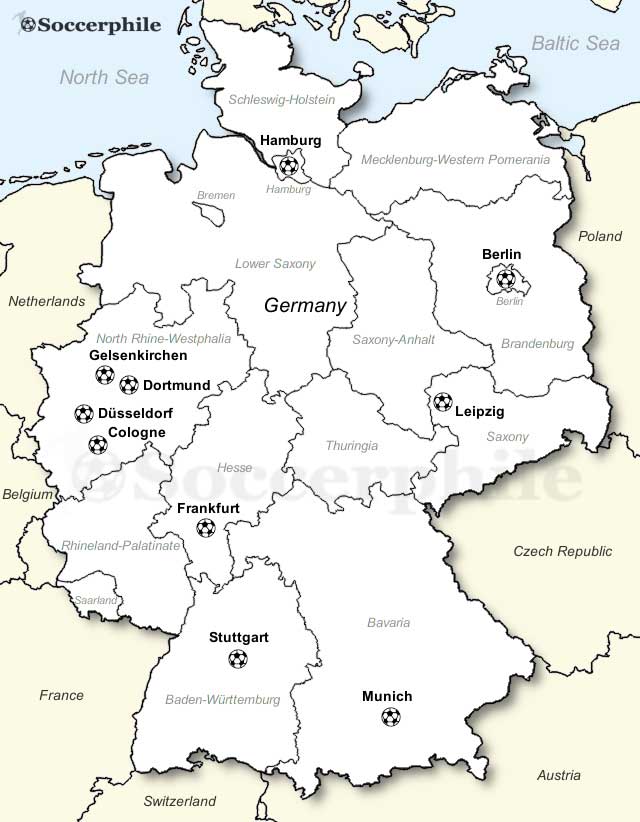
There are 10 host cities for Euro 2024 in Germany.
They are Berlin, Cologne, Dortmund, Frankfurt, Gelsenkirchen, Hamburg, Leipzig, Munich and Stuttgart. Düsseldorf, which was not a venue for World Cup 2006 is the tenth venue.
Hanover, Nuremberg and Kaiserslautern, host cities in 2006, will not stage games at Euro 2024.

Berlin
Berlin was restored as the German capital in 1990 after what was an often traumatic 45-year break. The optimism of that restoration has by no means led to denial of the trauma. As much as it looks forward, crafting a new face to fit its new direction, it maintains a relationship with its past, acknowledging it in all its glory and misfortune.
While untold dedication has been expended on the fastidious restoration of war-damaged monuments, graffiti daubed in the last days of World War II by triumphant Russian soldiers on the walls of the Reichstag has been preserved 'to remind'. A city like this keeps out a keen eye for what kind of past the future it makes will become.
With more trees than Paris, more bridges than Venice, and an impressive canon of Modernist architecture, the city - over a third of it woodland, parks and waterways - sits on the River Spree in the state of Brandenburg, north-east Germany, near the Polish border. With 3.6 million people, it is Germany's biggest city. A truly cosmopolitan place, barely half the citizens of Berlin were born there, one in seven from outside Germany.
A look at a map and Berlin would seems to have more museums than any capital city in Europe, though it does, in fact, lag behind London and Moscow in that league table. Favorites of ours are the Museum of Disgusting Food and the Bureaucracy Museum.
The Olympiastadion is the city's iconic sports stadium and the venue for the final of Euro 2024. It will also host games in Group B and Group D.
Hotels in Berlin - Booking.com
Cologne
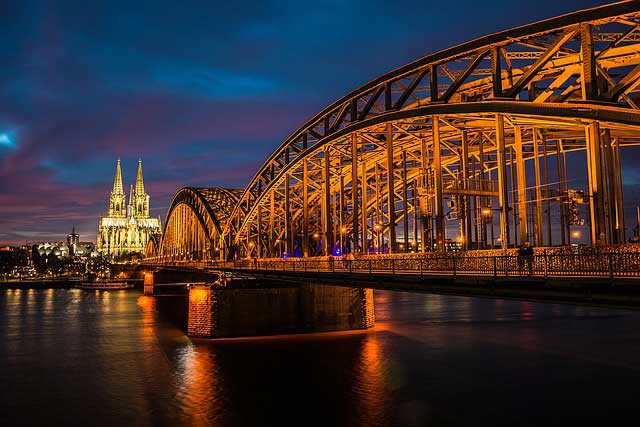
Cologne (Köln) on the banks of the River Rhein was originally a Roman colony, hence the name, and is Germany's oldest city.
Highlights include the magnificent Cologne Cathedral, a UNESCO World Heritage site revered for its stunning Gothic architecture and housing the Shrine of the Three Kings. Additionally, the city's Old Town, with its charming cobblestone streets, bustling squares, and vibrant atmosphere, offers much to admire including Hohenzollern Bridge, the most heavily-used railway bridge in Germany.
Köln's reputation as Germany's party city is backed up solidly by its famous thirst for the beer that shares its name with the local dialect: Kölsch. As for places to drink it: Cologne, with its more than 4,000 pubs, restaurants and ale houses, is reputed to have more drinking spots per head of population than any other town in Germany. Choose from historic pubs in the Altstadt, or more modern locales in the Innenstadt.
RheinEnergieStadion, which will be known as Cologne Stadium for Euro 2024, is the city's venue stadium for the tournament. Group A and Group E games will take place at Cologne Stadium.
Hotels in Cologne - Booking.com

Dortmund
Dortmund, first mentioned in about 880AD, found its place on the map in 1152 when the legendary German emperor 'Barbarossa' (Frederick I Hohenstaufen) rebuilt what had been a mere village and lived there for two years. It began to flourish in the 13th century after becoming a member of the Hanseatic League. It became an Imperial Free City in 1220 - a status it maintained until 1803.
Lying at the eastern end of the Ruhr region - famous for its once prodigious deposits of coal, especially the high quality coking coal used in steel manufacture - Dortmund was back on the world stage from the mid 19th century as one of the world's biggest industrial centers. However in 1980 its traditional industries fell into severe decline. Having in the '90s made yet another comeback, it is now equally prominent as a center of computer and internet technology, with well over half the population employed in commerce and service industries serving the whole North Rhine-Westphalia region.
Notable highlights include the Reinoldikirche, a medieval church with impressive Gothic architecture, and the Westfalenpark, a sprawling green space hosting various events and boasting the Florian Tower (Florianturm), providing panoramic views of its surroundings.
Westfalenstadion (BVB Stadion Dortmund for Euro 2024) will host matches in the city during the tournament. The stadium has a seating capacity of over 81,000 spectators, making it the largest football stadium in Germany in terms of seating capacity and one of the largest stadiums in Europe.
Hotels in Dortmund - Booking.com

Düsseldorf
Düsseldorf, the capital city of North Rhine-Westphalia in Germany, is renowned for its thriving cultural scene, vibrant nightlife, and picturesque riverside setting along the Rhine.
The city's historic Old Town, known as the Altstadt, features charming cobblestone streets lined with traditional breweries (brew pubs), stylish boutiques, and landmarks such as the Schlossturm (Castle Tower).
Düsseldorf also boasts an impressive array of museums and galleries, including the Kunstsammlung Nordrhein-Westfalen, which houses a fine collection of modern and contemporary art. With its annual events like the months-long Düsseldorfer Karneval (carnival) and the prestigious Art Düsseldorf fair, the city continues to attract visitors from around the world, offering a dynamic blend of tradition and innovation.
The Medienhafen area on the banks of the Rhine River is characterized by its striking avant-garde buildings and innovative design. This former harbor area has been transformed into a dynamic district, home to media companies, creative agencies, and upscale restaurants.
Dusseldorf International Airport, one of the three biggest commercial airports in Germany, is 12 minutes from the city centre via the S-Bahn urban railway system (S-Bahn trains #7 & #21).
Merkur Spiel-Arena (Düsseldorf Arena for Euro 2024) is the home ground of Bundesliga side Fortuna Düsseldorf and the city's venue stadium for Euro 2024.
Hotels in Dusseldorf - Booking.com
Frankfurt
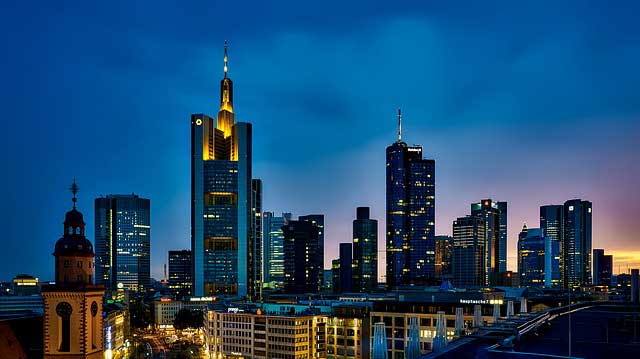
Frankfurt, often referred to as the financial capital of Germany is the location of the European Central Bank. A busy metropolis, the city of around 750,000 people is located along the banks of the Main River.
Skyscrapers and traditional timbered buildings are an indication of Frankfurt's reputation as a city of contrasts.
The moniker "Mainhatten" is sometimes given to Frankfurt (lit. "Ford of the Franks") due to its tall buildings.
The German National Library is located in the city, befitting a city whose most famous former citizen is Goethe, as is the Institute of Social Research. Goethe Haus, where the writer was born in 1749, is now a museum. The world's biggest book fair is also held in Frankfurt in late September/early October.
Situated in the heart of Frankfurt, the Waldstadion (called Frankfurt Arena for Euro 2024) is easily accessible by public transportation.
Hotels in Frankfurt - Booking.com

Gelsenkirchen
Gelsenkirchen dates back to the twelfth century but rapidly industrialized in the nineteenth century with the discovery of coal, becoming an important European center of iron and steel production, earning itself the name of the "city of a thousand fires" and drawing the attention of Allied bombers during World War II.
Now with the closure of the last coal mine in the area in the late 1990s, the city is striving to reinvent itself with new technologies such as solar energy and high-tech industry. Places to visit include Gelsenkirchen Castle, which was built from 16th - 18th century.
Other romantic buildings include the Palace Horst, Palace Berge as well as the Haus Lüttinghof. The Doppelbogenbrucke is a modern bridge.
The many canals in the area, which served the old coal and iron industries, are being converted for leisure activities on the British model. The many industrial heritage structures in Gelsenkirchen include Forderturm-Consol, Rhein Herne Kanal, Nordsternpark and the Himmelstreppe (Stairway to Heaven) monument.
The Arena AufSchalke has a seating capacity of around 62,000 spectators for football matches, making it one of the largest football stadiums in Germany. It is also capable of accommodating larger crowds for concerts and other events. It will host games in Group B, Group C and Group F.
Hotels in Gelsenkirchen - Booking.com

Hamburg
The Baltic port city of Hamburg is Germany's second city with a population of 1.8 million.
The city is defined by water with the wide majestic River Elbe and the port best explored by tour boat from Landungsbrücken, in St. Pauli or catch the enormous brick warehouses and the museums of the Speicherstadt and the new HafenCity docklands development nearby.
Interesting museums in Speicherstadt include the Dialog in Dunkeln - a museum creating the experience of being unable to see in urban, rural and jungle landscapes, The Hamburg Dungeon, the Spicherstadtmuseum, the Deutsches Zollmuseum - the German Customs Museum, and for model train buffs, Miniatur Wunderland, featuring the world's largest model railway.
The Reeperbahn ("Ropewalk") in the St. Pauli district is a center of Hamburg's nightlife and also the city's major red-light district.
The Volksparkstadion has a seating capacity of around 57,000 spectators for football matches. Situated in the Bahrenfeld district of Hamburg, the stadium is easily accessible by public transport, namely S-Bahn from the main station (about 35 minutes).
Hotels in Hamburg - Booking.com

Leipzig
Leipzig was once one of Europe's richest and most artistic cities.
Leipzig university dates back to 1409 and some of the great names of German music, literature and science: Bach, Goethe, Leibniz, Mendelssohn, Nietsche, Schiller, Schumann and Wagner lived in the city at some point in their lives.
Leipzig's early growth and wealth was based on book publishing, trade fairs and its famous university which attracted scholars from all over Europe. This prosperity was reflected in the arts, particularly music which has a long tradition in the city: The Gewandhaus Orchestra founded in 1743 is Europe's longest-established orchestra and was once conducted by Mendelssohn, the Opernhaus (opera house) dates back to 1693 and the famous Thomaner Choir was directed by Bach.
Red Bull Arena (Leipzig Stadium for Euro 2024) is the home ground of RB Leipzig. The stadium was originally opened in 2004 as the Zentralstadion (Central Stadium) and served as one of the venues for the 2006 FIFA World Cup. It will host games in Group B, Group D and Group F.
Hotels in Leipzig - Booking.com

Munich
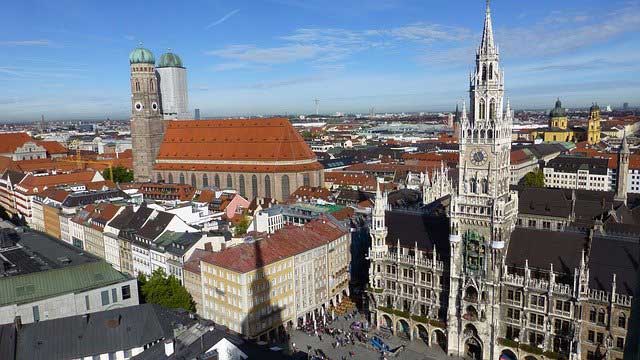
Munich, the capital of Bavaria, is a tourist's dream, particularly in the clement summer months of June and July.
The city boasts a collection of world-class museums, theaters, expansive parks, and the ghosts of many great artists, from Klee to Kandinsky, Strauss to Ibsen. Moreover, the city's annual Oktoberfest draws in hundreds of thousands of beer-swilling revelers.
Now a hi-tech modern metropolis and headquarters of Seimens and BMW, Munich has much to offer and is a magnet for foreign tourists and Germans alike.
The city is a great base to explore Bavaria's other top tourist destinations: Bamberg, Bayreuth, Regensburg, Nuremberg and Garmisch-Partenkirchen. The suburb of Dachau, the site of the first Nazi concentration camp, but a pleasant place to linger nonetheless is just 12 minutes away on the train or just over 20 minutes on the S-Bahn from Munich Hauptbahnhof.
The Allianz Arena opened in 2005 as one of the venues for the 2006 FIFA World Cup. It replaced the former Olympiastadion as the home ground of Bayern Munich and from 2005 to 2017 was also the home of TSV 1860 Munich. 1860 now play at the much smaller Grünwalder Stadion.
The stadium has a seating capacity of approximately 75,000 spectators for football matches, making it now the second-largest stadium in Germany for international games after the Westfalenstadion in Dortmund and just ahead of Berlin's Olympiastadion. For Euro 2024 it will be known as Munich Football Arena.
Hotels in Munich - Booking.com

Stuttgart
Stuttgart is an interesting blend of old and new. The Romans built a citadel around 90 AD in the lush valley of what is now the present-day city.
The name "Stuttgart" comes from a stud farm owned by the Duke of Swabia in the 14th-century. And on the city's coat of arms today is the image of, yes, a horse. The mid-19th Century witnessed the beginning of Stuttgart's rise to its position as one of the largest urban centers in Germany with a population of more than 630,000 inhabitants.
Today the capital of Baden-Württemberg is one of Europe's major industrial bases, with among others the headquarters of DaimlerChrysler, Porsche and Zeiss.
The city though is among the least concreted urban areas in Europe. More than two thirds of the city is parks, gardens, or woodlands. This can be seen clearly from the a 217-meter tall tv-tower built in the hills of of Degerloch. Stuttgart is also renowned for its ballet and orchestra.
The charming, easy-going university town of Tubingen is an easy day trip south by train. Similarly both Heidelberg and the spa town of Baden Baden are within easy reach.
The MHPArena (formerly the Mercedes-Benz Arena until 2023) in Stuttgart was originally opened in 1933 under the name "Neckarstadion" due to its location near the Neckar River. The Mercedes-Benz Museum is close to the ground as well as a Mercedes factory and the company's HQ.
For Euro 2024 it will be known as Stuttgart Arena.
Hotels in Stuttgart - Booking.com
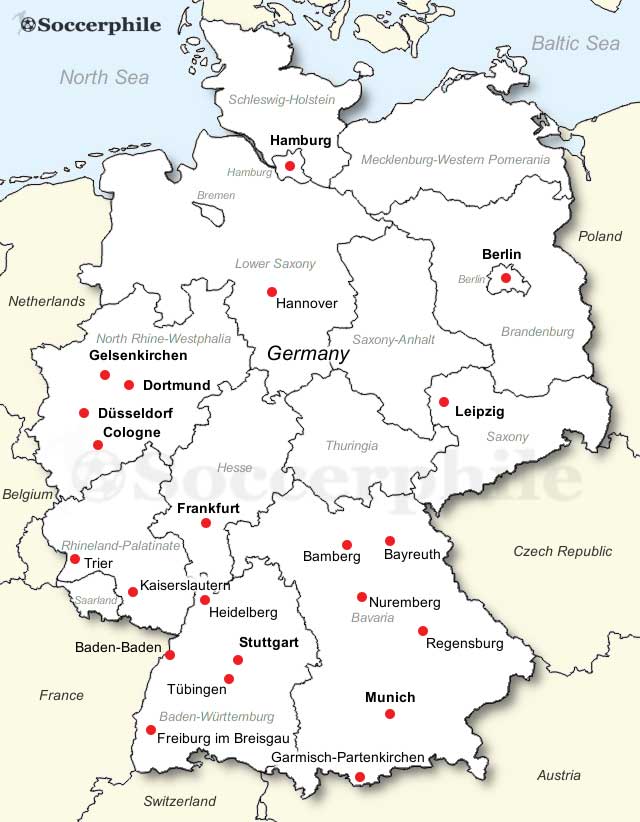
Euro 2024 Stadiums Map
Major towns and cities in Germany
Buy tickets for soccer matches around the world
©Soccerphile.com