
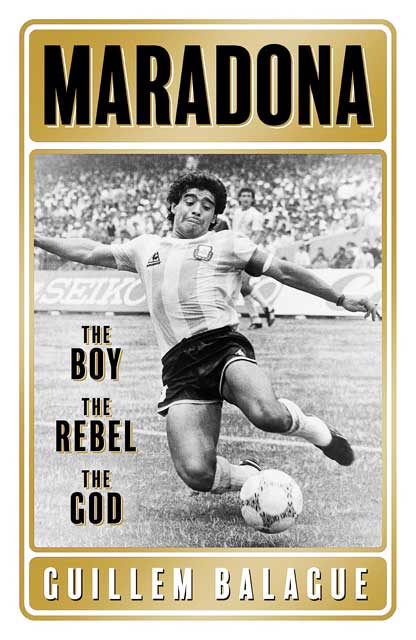
Slaves to the Maradona Myth: Maradona - the Boy, the Rebel, the God by Guillem Balague
Sean O'Conor
Diego Maradona died in 2020, four years after Johan Cruyff and two years before Pele, the other two great players of his generation.
Of this holy trinity of super footballers, Maradona was the only one I saw a lot of 'en vivo' during his career, most memorably dismantling England and the rest of the world at Mexico '86, his crowning glory.
The players we have watched we know the best and thus rate the highest. It was the same for those who worship Lionel Messi today, unable to compare him rationally to the greats of yesteryear.
The two Albiceleste legends intertwined at the 2010 World Cup of course, when Maradona coached Messi, but the pairing of two wizards failed to find alchemy in Africa and Argentina crashed out 4-0 to Germany in the quarter-finals. Messi had more shots in the tournament than any other player but failed to score, perhaps unable to master the Jabulani 'beach' ball.
Messi has inevitably always drawn comparisons with Maradona, his World Cup win at long last slaying the criticism that he could not match Diego's capture of the ultimate prize, but scratch the surface and the comparison peters out.
Messi is a god but for his football alone. Maradona, like Muhammad Ali, transcended his medium to become one of South America's most significant historical figures, let alone footballers.
"He interwove folk tales into his own history," Balague writes, elevating them to myths that readily became symbols of Argentina. Maradona the avenger of social ills, a representative for the humble and a rebel for the young (and) a poster boy for the Left."
Maradona's poverty-stricken origins, political spoutings and reign as the king of grotty Naples embodied the pibe (street urchin) totem of Latin American identity in a way Messi's comfortable years as a good family man in well-to-do Barcelona never could.
Messi trounces him for garlands at club level, but lives a conventionally mundane life beyond the pitch, free from scandal.
Maradona, by contrast, was never far from it. In 1999 while convalescing in Cuba he fathered four children by three different mothers. His agent Guillermo Coppola who accompanied him claims in the book to have slept with 700 women on the island, with his famous client not far behind.
While acknowledging Pele's global glow and Cruyff as the most influential innovator, a genius whose DNA runs through Pep Guardiola and others today, I cannot get away from the statue of Diego at the summit of the sport.
Nor can Guillem Balagué, England's go-to man on Spanish football and author of books on Liverpool, Mauricio Pochettino and modern messiahs Messi and Cristiano Ronaldo.
According to the author, there are dozens of books on Maradona already, mostly in Spanish. In English, Jimmy Burns' biography Hand of God stands out, a country mile better than the bombastic and somewhat ludicrous autobiography I am Diego. There are films too and also the only semi-glib Church of Maradona in Rosario, Argentina, something that did not need spelling out. It is not hard to see Maradona as San Diego, amid a pantheon of heroes and demi-gods men of yore sang songs about.
Whilst there is not much that can be added to the best-known life story in football, Balague has done his research well, including quips and comments of the time from various sources and emphasising the closeness and influence of those around Maradona. The Latin warmth and need for constant company, an attempt to recreate Maradona's childhood barrio of Villa Fiorito, was not generally understood by the Anglosphere.
Being an engaging personality himself and a Spanish speaker with an inside line to many in the football world, Balague had some extra keys to the files.
His biography of Maradona is subtitled 'The Boy, The Rebel, The God', a life in three stages and a holy trinity of sorts. It is the third act, the ascendance to soccer heaven, which is the most interesting and really sets Maradona apart from other great footballers.
Referring to the Hand of God match, Balague writes,
"The whole world saw one man single-handedly, in more than one sense of the phrase, lift the mood of a depressed and downtrodden nation into the stratosphere."
It was his miracle to prove the doubting Thomases wrong, yet also 50% dishonest.
The various acts of his life are laid out in detail - Boca Juniors, Barcelona, the two title wins at Napoli, Sevilla, back to Boca, an extended swansong around the world inc. Cuba as well as the three World Cups.
The final descent was long foreseen - Maradona's drug abuse and sagas of pain while a player marked him out for an early grave, but the ending was still tragic.
"The shell of Maradona ghosted from Dubai to the USA, from Belarus to La Plata in Argentina and Sinaloa in Mexico," he writes. "Various projects satisfied the illusion of his relevancy - and his bank account - despite his damaged body's protests."
Yet a combination of brain, pulmonary, liver and cardiovascular damage coupled with high blood pressure, excessive drinking and painkiller intake blew full time on the life of such a legendary footballer shortly after his 60th birthday.
His final days were spent in a modest ground-floor flat in Buenos Aires where he confined himself during the pandemic, finally leaving this earth on the 25th of November 2020.
For years he had tired of being 'Diego', unable to lead anything approaching a normal life, while at the same time going along with the Camorra, Fidel Castro or anyone else who wished to tag alongside the world's greatest. His socialist beliefs sat alongside taking money from big business and working in the Middle East, but he wore his inner conflicts on his sleeve for all to see.
So, when he died the whole football world cried. Even those who thought he was a cheat still acknowledged his greatness and felt a sense of loss.
As Balague notes, "Peter Shilton was quicker to react than when he came off his line in 1986".
Three years into the post-Maradona era one is left wondering how much we were voluntary slaves to the cult of Diego and wilfully blind to his manifest failings. In other words, why is not Messi automatically considered greater than Maradona given his exemplary off-field conduct in addition to his amazing football?
The answer must be that we love a good yarn and stories need villains as well as heroes, or as Balague puts it, "Diego instinctively sensed that fairy tales triumph over reality in our battles of conscience."
The biography concludes with the author heading for Naples as soon as Maradona died. There he meets "a world of smoke and masculine martyrdom" outside the Stadio San Paolo, now renamed after its legendary hero.
"Two hours before the match, almost 10,00 had congregated…chanting 'ho visto Maradona (I've seen Maradona)', even though they hadn't…without warning thousands of mostly young men surrounded the ground and lit red flares that illuminated the stadium…from a distance the picture was magnificent."
The chaos surrounding his state funeral in Buenos Aires chimed perfectly with his chiaroscuro life too, as police fought mourners turned rioters in a cathartic ritual replete with Latin passion.
Maradona's footballing talent came from heaven, but his character embodied the duality of man - half dark and half light, which makes him in a sense the most human hero of them all - divinely inspired yet flawed too.
This retelling of the Maradona myth is far from the final word but is up there with the best.
W&N, 2022
Paperback, 384 pages
ISBN: 978-1409157779
Buy Maradona - the Boy, the Rebel, the God from Amazon USA | UK | Japan
Read more on South American soccer
© Sean O'Conor & Soccerphile
Buy tickets for soccer matches around the world