
UK Stadiums: Fratton Park, Portsmouth, England
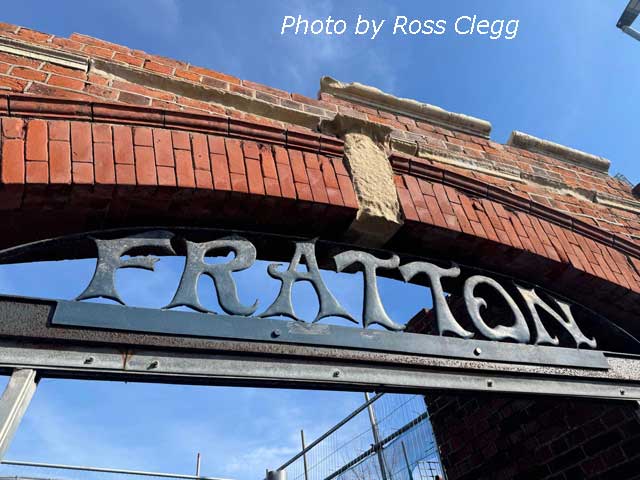
Fratton Park, is the home of Portsmouth FC. The 20,899-capacity ground is located on Portsea Island in Portsmouth, making it technically 'the only professional English football ground not located on the mainland of Great Britain'. Portsmouth have used Fratton Park as its home ground throughout its history.

Stadium Overview
Fratton Park was built in 1899 by Alfred H. Bone, a Portsmouth-based architect and a founding director of the football club.
In July 1948, the ground hosted a fixture between the Netherlands and Ireland, as part of that year's London Olympics, one of only two grounds outside the capital to host matches in the Olympic football tournament.
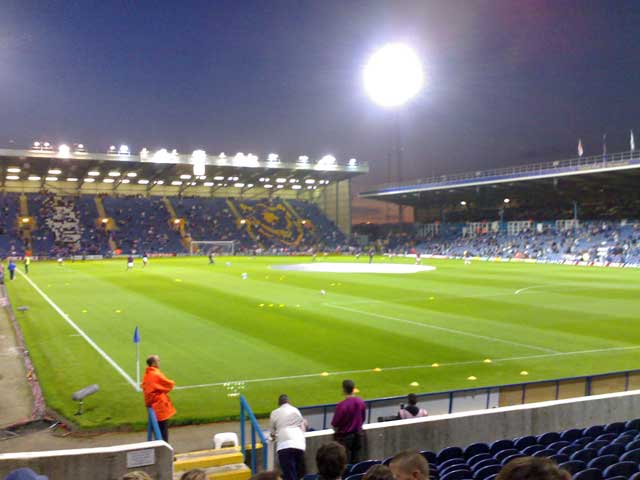
The ground's four corner floodlight towers became a major symbol of Fratton Park and a neat landmark for visiting supporters. However, lamentably for old-school fans, the towers have been replaced by modern roof-level lights, except for the construction in the north-west.
Fratton Park is affectionately nicknamed The Old Girl by Portsmouth supporters. The supporters see the ground as a special vintage site, like that of a classic car or ship.
Stadium Stands
The stadium has two 2-tier stands, the North and South Stands. The Milton End and the Fratton End are single-tiered. Away supporters are placed in the Milton End.
The North Stand saw substantial refurbishments during the COVID-19 coronavirus lockdown in 2020. The roof was replaced, and external cladding and beams were renewed.
The refurbished Lower North reopened on Saturday, 23 July 2022, for a friendly match versus Coventry City.
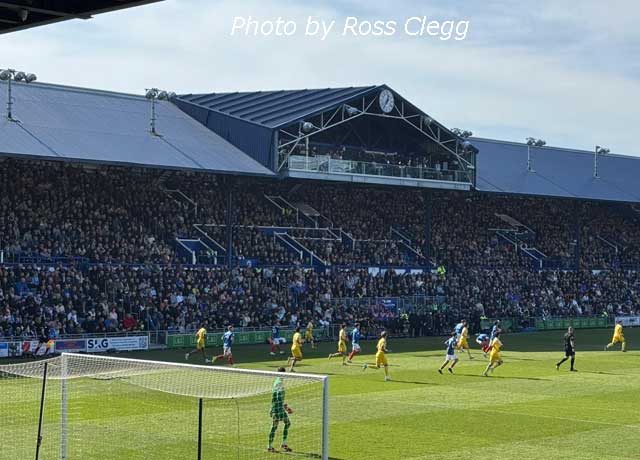
The South Stand was once called the Grand Stand. The dressing rooms are tucked away in this stand. At the rear end of the stand is an area reserved for journalists. It is behind the director's box. The new lower tier of the South Stand has nine rows of seats. But as it does not correlate with the initial roof designed by the famed architect Archibald Leitch, some of the seats are vulnerable to outside elements.
The capacity of the Milton End is 3,196. In summer 2018, a large video screen was installed. Behind the stand, there is a public alleyway known as 'Specks Lane', known for its view of terraced housing on Alverstone Road.
Jimmy Dickinson's legacy is remembered with the seating design at The Fratton End. It is named so because it is the nearest stand to Fratton railway station. The stand houses the most vocal members of the Portsmouth crowd and has established a solid reputation as a hostile part of the ground. According to reports from the 1960s, some of the younger Pompey faithful wanted their territory, and as a result, the Fratton End became notorious.
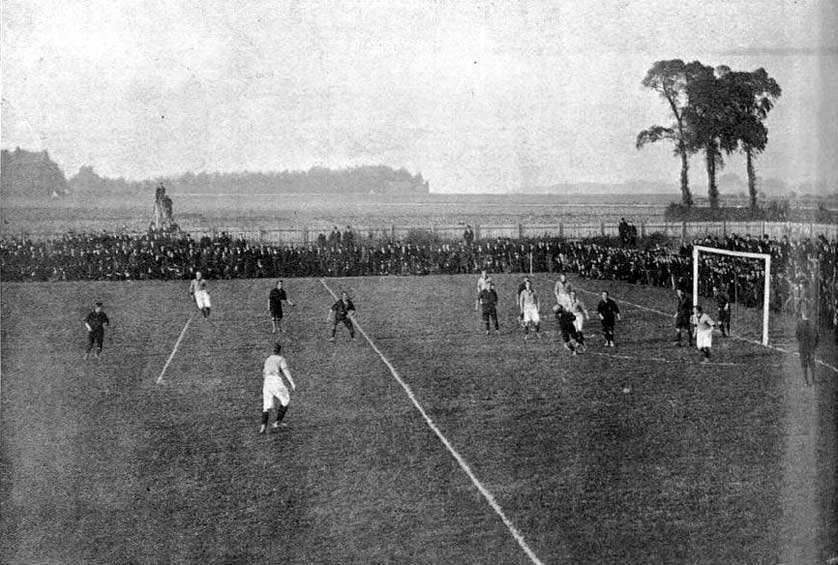
The ground opened in 1899 with a friendly win over neighbors Southampton and has been the club's home ever since. The first competitive fixture was 3 days later, a 2-0 win against Reading, in the Southern League First Division.
Portsmouth FC, nicknamed Pompey, currently compete in the Championship.
Relocation Ideas
Fratton Park has been the home of the football club throughout its history. When Pompey achieved promotion to the Premier League in 2003, the ground stood out as tattered, especially when clubs such as Leicester City and Southampton were moving to modern venues. After the Taylor Report was published in 1990, mandating that all clubs in the top two leagues have all-seater stadiums, Portsmouth began considering relocation. Fratton Park eventually became an all-seater venue in the following years.
The Precursor Clubs (History)
The owner of the Portsmouth-based Brickwood's Brewery, John Brickwood, founded the Portsmouth Football and Athletic Company Limited in April 1898. The company had a capital of £8,000 amongst its chairman and five directors. This is the origin of the current Portsmouth FC.
Brickwood felt a need to create a football club that would pursue professionalism, as all of Portsmouth’s precursor clubs had failed to establish themselves long-term. The most famous of which was the Royal Artillery Football Club, which consisted of men from the Portsmouth regiment of the Royal Artillery arm of the British Army. Portsmouth in the 1890s was a significant Royal Navy base and an army garrison town.
Royal Artillery Portsmouth opened its account in October 1894 against Portsmouth Grammar School in a friendly. The match took place on the western side of the United Services Recreation Ground complex, located on Burnaby Road.
Royal Artillery Portsmouth were nicknamed The Gunners, because of their artillery capabilities. They were also nicknamed Pompey, which is an endearing term for the town.
The club ultimately faded in 1901. Although they proclaimed their adherence to amateurism, it became increasingly difficult to prove to authorities it was the case, as players were rewarded by the army for their performances. The demise of Royal Artillery Portsmouth created a footballing vacuum in the city, prompting Brickwood to take action.

Early Club History of Portsmouth FC
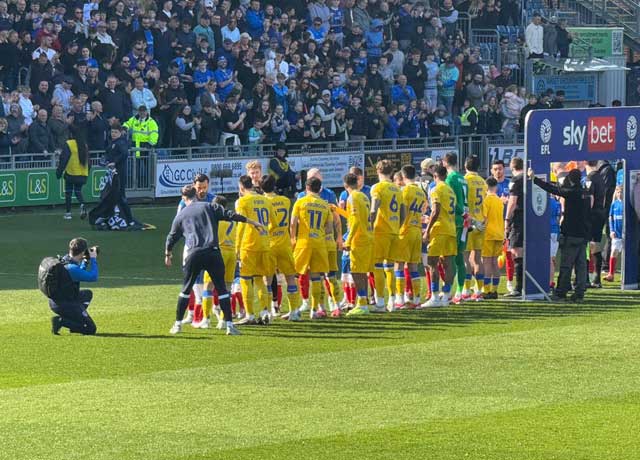
Portsmouth Football Club was founded in 1898, with its roots tied closely to the city's naval and dockyard heritage. The club joined the Southern League in 1899 and quickly established itself as a competitive side. In the early years, Portsmouth gained recognition for strong performances, eventually earning promotion to the Football League in 1920. The club's foundation and growth reflected the passion for football in a working-class port city, and the team soon became a significant presence in English football.
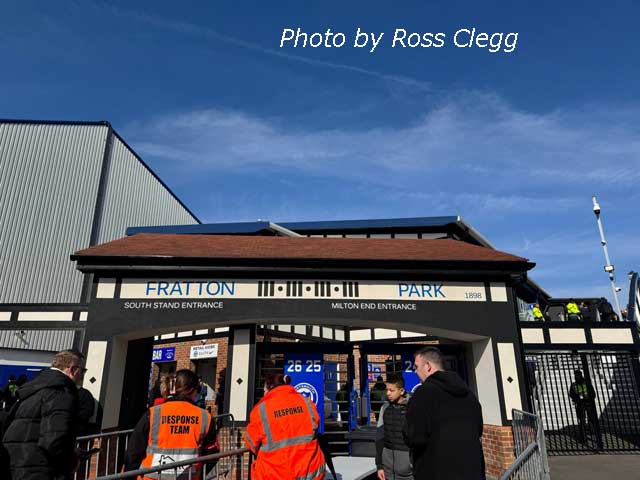
The early directors of th club proposed a budget of £5,000 on up to five acres of agricultural land at Goldsmith Avenue near the village of Milton. They also promised that the land would be for cycling, athletics and cricket matches, not just football. To ensure a steady stream of customers, the ground was to be built within walking distance of Fratton railway station, hence the name.
When Fratton Park opened in August 1899, more than 1,000 people attended the event to see a humble potato field transform into a modest football ground.
The name "Fratton Park" is a slight misnomer. It was intended to entice supporters from the wider Hampshire community, and concealed the fact (to the best of their abilities) that the stadium is a mile away from the Fratton district.
There has been a persistent rumour that Sir Arthur Conan Doyle played for Pompey as the club's first goalkeeper, but he turned out for Portsmouth AFC, an organization that existed from 1884 to 1896. He took on the pseudonym of AC Smith whilst on the pitch.
Frank Brettell was announced as Portsmouth's first manager-secretary in February 1899. Brettell had numerous contacts with the Northern clubs. He helped the club sign players such as the Preston pair Sandy Brown and Bob Blyth, but also Tom Wilkie from Liverpool. The club joined the Southern Football League Division One almost immediately, which was unusual for an English team not to go through a probationary period in the lower leagues.
For the 1901-02 season, Pompey appointed Bob Blyth as manager. They were crowned champions of the Southern Football League. On 5 July 1904, Portsmouth Chairman and Brickwoods Brewery owner, Sir John Brickwood was knighted by King Edward VII.
Portsmouth came close to another silverware in the 1906–07 Southern Football League, but lost out to Fulham by two points. For the 1909–10 Southern Football League, they discontinued wearing pink and maroon home shirts and changed their colours to white shirts and navy blue shorts.
During 1913-14, Portsmouth introduced their now iconic crescent moon and star crest. Pompey ended that campaign in ninth.
On 24 April 1916, in the midst of The Great War, Portsmouth and Southampton had their squad split into two and played out two charity matches on Easter Monday at Fratton Park and The Dell simultaneously. Portsmouth won their home match 7-0, while Southampton were defeated 2-3 at their home ground.
The American and Canadian armies crossed paths in baseball at Fratton Park in June 1918, with the Americans emerging victors 4-3.

After The Great War
As winners of the 1923-24 Third Division South, Portsmouth won promotion to Football League Second Division. Prolific marksman Willie Haines bagged 28 goals for the season.
More improvements were made on Fratton Park, nicknamed The Old Girl. A new South Stand was designed by Archibald Leitch, likely the most important figure in British football architecture. It was unveiled before an August fixture against Middlesbrough.
Portsmouth’s upward trajectory continued in 1926-27, winning promotion by finishing second. The highlight of the season was the 9-1 home annihilation over Notts County, which is the biggest win in the club’s history. It was a moment of reckoning for Southern football, as they became the first team south of London to be in the top table.
1928-29 was a rollercoaster of emotions. They were on the wrong end of the 10-0 drubbing at the hands of Leicester City at Filbert Street, the club’s biggest loss still to this day. Pompey secured safety by the skin of their teeth. In the FA Cup, however, there was much to celebrate. They reached the final and played Bolton Wanderers in front of 92,576 spectators at Wembley Stadium. But Bolton showed their class, earning a decisive 2-0 win.
There was more FA Cup heartache in the 1934 final. Their opposition was Manchester City, who had Sir Matt Busby playing in the right half position. Portsmouth delivered a stronger performance than they had against Bolton, with Septimus Rutherford opening the scoring in the first half. However, his effort was ultimately overturned by a brace from Fred Tilson.
By this time, Portsmouth were an established side in the top flight but were nowhere near challenging for the title. Their history was to change a little in the 1939 FA Cup final. Bert Barlow and John Anderson got themselves on the scoresheet before half-time, and Pompey were firmly in the driving seat minutes after the interval thanks to Cliff Parker. The ex-Doncaster forward completed the 4-1 rout with a brace. It was the third time lucky for the club and manager Jack Tinn.

Stadium Miscellaneous
The ground staged matches during the 1948 London Olympics and also in 1956 the first football league match under floodlights was played at the stadium when Pompey took on Newcastle United on 22 February.
The Football League is Abandoned
The 1939-40 First Division season started on 26 August 1939, but the Football League was halted indefinitely on Sunday 3 September after the British declaration of war on Germany. Portsmouth were 18th in the standings.
During his wartime visits to Portsmouth, Field Marshal Montgomery developed a growing interest in the football club and was eventually appointed honorary president. His idea to change the socks to red, to commemorate the sacrifice of British servicemen lost in World War II, is yet to change to this day.
As the city was a key naval base for Britain in the Second World War, it was targeted mercilessly by the German war machine. The club thought their FA Cup trophy was part of the allure, and so they routinely moved around the city, including club boardrooms, bank vaults and under Jack Tinn's bed. On 8 May 1945, also known as Victory in Europe Day, the trophy was paraded in the Portsmouth streets.
The Glory Days
1948-49, Portsmouth's Golden Jubilee season, is the stuff of legend. Led by Bob Jackson, who assumed the role after the departure of Tinn, the team brought the league title to the town for the first time. They were within touching distance of an unthinkable double, but that dream was extinguished when Leicester ran out 3-1 winners in the FA Cup semi-final at Highbury. Despite losing their final two league games away at Arsenal and Manchester United, they finished top with a five-point cushion.
Peter Harris was the inspiration in front of goal in their first title, whilst Ike Clarke led the line for the following campaign. Portsmouth were to win the league once more, cementing a golden era. The 1949-50 season was a much closer affair, as Portsmouth levelled on points with Wolverhampton Wanderers after the final day. The Hampshire side claimed the title because they had a more favourable goal average. Their FA Cup dreams were crushed after losing to Man Utd in the fifth round after a replay.
Jackson would leave his post in 1952 and join Hull City. Eddie Lever was handed the responsibility of taking the team back to the summit. Instead, Portsmouth had to be concerned about relegation, finishing four points above the dotted line in 1952-53.
Fratton Park made history in 1955-56 when it hosted Newcastle United. The match was the Football League's first-ever floodlit evening game, illuminated by the floodlights on top of the North Stand and South Stand roofs.
Lever was out the door in April 1958. The 1958-59 season in English football signalled general progress, as there were now four divisions. But the campaign was characterised by melancholy for Pompey, as their 32-year stay in the top table came to an end after collecting a meagre 21 points.
Top Flight No More
The descent of the club during this period was spectacular and alarming. They survived the 1959-60 second division by two points. In the following campaign, they suffered relegation. Portsmouth became the first top-flight champions in English history to play in the third tier.
Under the guidance of George Smith, Pompey bounced back with immediacy and won the third division championship. Smith would be in the post until 1970. The club became the embodiment of mediocrity in the second tier during Smith's tenure, as they broke the top ten just twice, in 1963-64 and 1967-68. There was also little to cheer for in both of the domestic cup competitions.
John Deacon arrived at Fratton Park as chairman in 1972, but it did not provide the results that the supporters had anticipated. Despite the best efforts of Norman Piper on the pitch, Portsmouth finished dead last in 1975-76.
Life in Division Three was miserable for Portsmouth in the mid-seventies. They were mired in a financial crisis and found themselves in a position where they needed to raise £25,000 to pay off debts and avoid bankruptcy. After narrowly avoiding relegation in the 1976–77 season, they were demoted the following year.
English football had a persistent problem with hooliganism in the late seventies and throughout the eighties, and Portsmouth had one of the more notorious fan bases in the country. The pick of the bunch was the 6:57 Crew, whose name came from the train they would get to reach London on away days. Their "achievements" and enduring legacy are compellingly captured in the Derby Days documentary produced by Copa90. Therefore, this stadium guide will omit the section about Portsmouth's rivalry with Southampton.
Relegation to Division Four was unthinkable, but thanks to the excellence of coach Frank Burrows, they were not to remain in the division for long. A fourth-placed finish in 1979-80 was enough to clinch promotion.
Former Fulham manager Bobby Campbell was in the hot seat for the highly enjoyable 1982-83 season. Portsmouth stormed the Third Division, winning the title ahead of Cardiff City by five points.
At the latter end of 1983-84, Campbell was replaced by Alan Ball, an influential member of England's World Cup-winning squad in 1966. Pompey had to face two promotion near-misses from 1984 to 1986, ending in fourth both times.
Promotion spots in 1986-87 had become extra-difficult to obtain following the introduction of the playoff system. Portsmouth slid into second ahead of Oldham Athletic and were back in the promised land after an absence of nearly 30 years.
Back in the Big Time, But…
But celebrations of reaching the top flight were soon dampened after an immediate relegation and the news of financial difficulties following the 1988 sale by John Deacon.
Despite the club being in a healthy place, at least on the pitch, Alan Ball announced his resignation in January 1989. Portsmouth then went on a managerial merry-go-round, appointing and firing John Gregory, Frank Burrows and Tony Barton, though Barton was only a temporary hire.
Under the tutelage of Jim Smith, they progressed to the semi-finals of the 1991-92 FA Cup but were defeated by eventual winners Liverpool.
Portsmouth were real contenders for promotion in the 1992-93 First Division. They were level on points with West Ham United after the final league games, but the goal difference rule favoured the East Londoners. The playoff would decide their fate.
The opposition in the semis was against Leicester City, but instead of heading to their usual Filbert Street, Portsmouth travelled to the City Ground because of construction. The game described by Paul Weaver of The Guardian as "dreadful" was lit up slightly after a wonder goal from Leicester's Julian Joachim. The return leg finished 2-2, meaning the goals by Alan McLoughlin and Bjørn Kristensen for Portsmouth counted for little.

El Tel Stirs the Pot
Terry Venables became a consultant in the summer of 1996. Although his stint at Fratton Park was brief, his influence was widely felt. He soon became chairman after buying the shares for £1. Despite the chaos in the boardroom, the results in the FA Cup were excellent, especially the 3-2 victory over Leeds United at Elland Road in round five. In the quarter-finals, however, Pompey were outclassed by Chelsea 1-4 at home. The visitors were packed with talent, with Dennis Wise, Mark Hughes and Gianfranco Zola all having a stellar game.
Venables started to increasingly interfere with matters on the pitch in 1997-98. The Tottenham legend was juggling two jobs at this time, the other being the manager of the Australian National Team. Venables wielded his power by bringing a handful of Australians to Fratton Park, but most of them flopped. One of the few exceptions was John Aloisi, who was a member of the squad for the World Cup held in Germany in 2006. Portsmouth signed the left-footed wizard from Cremonese in Serie B. His performances soon attracted the attention of Premier League side Coventry City. He left the Hampshire club in the middle of 1998-99. The fact that Venables was spending most of his time in Sydney did not sit well with the Pompey fans, and he departed eleven months after joining.
Financial problems and Portsmouth Football Club go hand-in-hand. The club went into administration in December 1998, but was saved by Serbian-American businessman Milan Mandarić. Mandarić, who was born in present-day Croatia, has a lengthy football portfolio, previously owning Leicester and Sheffield Wednesday.
Mandarić appointed Tony Pulis in January 2000. Unsurprisingly, the expertise of Pulis steered Portsmouth clear of relegation, but his fractured relationship with the owner soon brought an end to his reign. Portsmouth finished 18th in 1999-2000. Steve Claridge, who was still a player, was tasked to fill in, but his tenure was brief and he was soon back to playing again.
Portsmouth appointed Graham Rix as boss on February 25, 2001. It was a controversial and unpopular decision, as he had been jailed in 1999 for a sexual offence. He did enough to keep Pompey afloat, but it was wise of the club to give Harry Redknapp the chance to manage once he became available.
Rescued by Redknapp
In early 2002, Harry Redknapp was "promoted" to the role of head coach after Rix's dismissal. Redknapp had been working as director of football. Jim Smith joined the coaching staff, despite declining the offer initially.
Ahead of 2002-03, Redknapp worked his magic in the market, also known as "wheeling and dealing", by signing big names. Steve Stone, Tim Sherwood and Paul Merson came through the door. Pompey were more or less untouchable in the league and won the championship with a game to spare. They concluded the campaign with a flourish, demolishing Bradford City 5-0 away at Valley Parade. The star of the season was undoubtedly Bulgarian striker Svetoslav Todorov, a newly signed player from West Ham in the summer.
Premier Pompey
Portsmouth were to participate in the Premier League for the first time in 2003-04. This is the period modern-day supporters are surely most fond of. The main source of goals switched from Todorov to Yakubu Ayegbeni, an unknown quantity having played in Israel with Maccabi Haifa and Hapoel Kfar Saba. It was a hugely satisfying season, not just because of their 13th-placed finish but also for remaining unbeaten against the Invincible Arsenal team at home and away.
2004-05 started well enough, but dark days were afoot when Redknapp walked away in November following a disagreement with Mandarić. The incompetence of Velimir Zajec almost cost Portsmouth dearly, but Frenchman Alain Perrin performed an admirable escape act after being appointed in April. The club had a decent shot at winning the League Cup but were eliminated in the quarter-finals at Vicarage Road against Watford.
The hero of the previous campaign, Perrin, was quickly becoming the villain after a string of terrible results. Perrin was relieved of his duties in late November 2005, the final game being a 0-3 loss at Anfield versus Liverpool. Joe Jordan was appointed caretaker, but he was powerless to prevent his team from losing to Chelsea and Manchester United. In a stunning turn of events, Harry Redknapp returned to Fratton Park after resigning from his job at Southampton. The feel-good factor soon arrived, beating Fulham and West Bromwich Albion in December.
Yet, Portsmouth looked certain to be relegated. But they went on a hugely impressive spell where they won six of their nine games from March to April. The run started with a 2-1 home win versus Manchester City and concluded with a 2-1 victory over Wigan Athletic at the Brick Community Stadium. They survived the league with a four-point cushion.
2006-07 was a season of consolidation. Portsmouth relied on numerous veterans. Some of the names include Sol Campbell, Andy Cole, Lauren, Nwankwo Kanu and Pedro Mendes. They were placed ninth, within touching distance of the UEFA Cup.

2007-08
The European dream was achieved by winning the 2007-08 FA Cup. After negotiating an awkward tie against Preston North End at Deepdale in round five, Portsmouth had a daunting task at Old Trafford in the following round. The quarter-final match has since become famous for its enthralling moments.
Edwin van der Sar, the starting goalkeeper for Man United, was substituted at half-time. His replacement, Tomasz Kuszczak, was red-carded in the latter stages for upending Milan Baros. Rio Ferdinand was handed the gloves, asked to save Sulley Muntari's spot-kick, but he failed. Portsmouth survived a late salvo of Man United shots and held out for a 1-0 win. This victory served as revenge for the 0-2 loss at the same ground in January. The game is famous for the wonderful knuckleball free kick from Cristiano Ronaldo.
Compared to a trip to Old Trafford, a semi-final tie against Championship West Brom looked like a straightforward test, but it turned out to be anything but. Kanu scored the decisive goal, but West Brom delivered a spirited performance and held their own throughout the match.
The 2007-08 FA Cup was a tournament for the underdogs, as Cardiff City, another Championship team, faced off against Pompey at Wembley Stadium. Portsmouth under Harry Redknapp were excellent in game management, and limited Cardiff to a handful of goalscoring opportunities. Kanu was the hero once more, tapping in from close range. The goal clinched Portsmouth's second FA Cup.
Portsmouth and Reading left an unforgettable mark on 29 September 2007, producing the highest-scoring game in Premier League history. Visitors Reading, who were relegated that season, were impressive under Steve Coppell the previous campaign. Benjani Mwaruwari helped himself to a hat-trick in a 7-4 win. Hermann Hreiðarsson, Niko Kranjčar and Muntari were also on the scoresheet. The scoring only ended in the 94th minute when Sol Campbell put one through his own net. The game would have had a goal more had Papa Bouba Diop's diving header not been given incorrectly as offside.
2008-09 and Europe
Ahead of 2008-09, which included a UEFA Cup adventure, Portsmouth strengthened in the forward department by acquiring Peter Crouch for a fee of £11,000,000. They were handed a couple of heavy defeats in the early stages of the season, losing 0-4 at Stamford Bridge and 0-6 at the Etihad Stadium.
The UEFA Cup began in October at the Estádio Municipal de Braga versus SC Braga. The Portuguese club showed just how unforgiving the European stage is in a 3-0 win. Three days after the defeat, Harry Redknapp jumped ship to Tottenham Hotspur.
Portsmouth wanted to amend in a home fixture but faced a jaded yet star-studded AC Milan. The Fratton Park faithful were in dreamland after 73 minutes due to the goals from Younes Kaboul and Nwankwo Kanu, but the drama wasn't finished. A famous coup escaped them after Ronaldinho delivered a beautiful free-kick goal and Filippo Inzaghi toe-poked an equaliser in the final minutes.
Hopes of qualification for the next round ended after a 2-3 loss to VfL Wolfsburg at the Volkswagen Arena. Although Pompey were ahead at one point because of Jermain Defoe and Arnold Mvuemba, Wolfsburg completed the turnaround when Zvjezdan Misimović punished an error by David James.
Portsmouth rounded out their tournament with a comfortable 3-0 win over SC Heerenveen. Crouch headed home a Marc Wilson cross late in the first half before bagging his second less than two minutes later. Hermann Hreiðarsson completed the routine win late in the day.
Although results in the latter end of the season were concerning, Portsmouth remained in the Premier League by finishing 14th.
The 2009-10 Financial Crisis
Their luck in the top flight ran out in spectacular fashion in 2009-10. They were pillaged by the league's big boys in the summer transfer window, letting Glen Johnson leave for Liverpool and Crouch reuniting with Redknapp at Tottenham. Sylvain Distin also departed for Everton. Portsmouth were economical with their purchases. They signed Steve Finnan and Antti Niemi on a free and brought in Frédéric Piquionne on loan from Olympique Lyonnais. Kevin-Prince Boateng joined the club from Spurs late in the window.
This lack of spending was due to the financial crisis they had to deal with before the start of the season. In October 2009, the club acknowledged that some staff members had not received their salaries. Serious problems began to mount in the summer when Israeli businessman Alexandre Gaydamak agreed to sell the club to Sulaiman Al Fahim in principle. The Dubai-born Al-Fahim is an unsavoury character to say the least. In 2018, he was sentenced to five years in prison after he had stolen £5m from his wife to fund the purchase. His ill-fated six-week ownership ended when he sold it to Ali Al Faraj. On 5 October 2009, al-Faraj purchased a 90% stake in Portsmouth through a consortium named Falcondrone Ltd.
Troubles deepened for Portsmouth when the details of the transaction became public. Al-Faraj had financed the purchase of the club through a loan from Balram Chainrai's company, Portpin Ltd. Soon, al-Faraj defaulted on his payments, so Chainrai was now the owner. Chainrai placed Portsmouth into administration in a matter of weeks. On 17 March, Portsmouth were docked nine points for entering administration. Relegation was confirmed there and then.
This fiasco served as a warning for the Premier League how easy it was for questionable actors to buy and sell English clubs. Since then, the league has tightened its rules on ownership.
On the pitch, Pompey would lose their opening seven Premier League matches. Manager Paul Hart was sacked in November and replaced by Avram Grant. Results in the league were grim, but Pompey found respite in the FA Cup. In the fifth round, Portsmouth trounced third-tier Southampton 4-1.
In the semi-finals, Redknapp's Tottenham were overwhelming favourites, but they were picked apart in extra-time through the goals from Piquionne and Boateng.
Their opponents in the final were Chelsea, who were running riot in the league and were gunning for the double under Carlo Ancelotti. The gulf in quality was clear to see between the top team in England and the league's bottom side, as Frank Lampard, Didier Drogba, John Terry and Salomon Kalou all struck the woodwork. Having said that, only Drogba's free-kick separated the teams. Before the interval, Kevin-Prince Boateng made himself public enemy number one in Germany for injuring Michael Ballack, making him unavailable for selection in that year's World Cup in South Africa.
Under normal circumstances, Portsmouth would have qualified for the UEFA Europa League, but their financial crisis led to their entry being denied.
A Painful Period
Pompey started afresh for life in the 2010-11 Championship under Steve Cotterill. Many of their influential players departed, namely Boateng, David James and Tal Ben Haim.
It was revealed that Portsmouth had come out of administration in October 2010. Although they ended the campaign without a win in their last eight, Portsmouth escaped relegation.
2011-12 was a hard watch for the supporters. Cotterill agreed a compensation package to be enabled to join Nottingham Forest in October, eventually replaced by Michael Appleton in November. The new manager did not get off to a winning start, losing 0-2 at Vicarage Road against Watford.
But there were bigger problems in the boardroom. On 23 November 2011, a Europe-wide arrest warrant was issued for owner Vladimir Antonov by Lithuanian prosecutors. They wanted to question him as part of an investigation into alleged asset stripping at Snoras Bank. A day later, he was arrested in London. Unsurprisingly, the Russian national resigned from the job at Fratton Park soon after.
In February 2012, Portsmouth were forced into administration again. As punishment, the league deducted 10 points from them. Administrator Trevor Birch disclosed the scale of the problem, admitting debts were totalling around £58 million, including unpaid wages and tax liabilities.
Results on the pitch were nothing special, but had it not been for the 10-point deduction, Pompey would have survived. What really quashed their hopes in the league was the games from 7 February 2012 to 17 March 2012, where they amassed three draws and six defeats from nine. On April 7, Portsmouth travelled to the St Mary's Stadium and took on their fiercest rivals, Southampton. The two teams were heading in opposite directions. The upwardly mobile Saints under Nigel Adkins were full of future Premier League regulars, including Adam Lallana, Morgan Schneiderlin, Jose Fonte and Jack Cork. Southampton were Premier League-bound, while Portsmouth were facing an existential crisis.
Billy Sharp opened the account for the home side, but Portsmouth were level before the break thanks to Chris Maguire. It looked like Saints would take all three points when Sharp bagged his brace in the 89th minute, but David Norris' clean volley sent the Pompey faithful into bedlam in the away end. The goal is considered one of the greatest moments in Portsmouth's recent dark history. Pompey concluded the season with a defeat at the City Ground against Nottingham Forest.
There was a mass exodus ahead of 2012-13. Pompey were to be relegated again, this time finishing bottom. As terrible as the situation was, there were reasons to be cheerful as the Portsmouth Supporters' Trust made significant progress to become the owners of the club. In November 2012, manager Michael Appleton departed for Blackpool.
On 19 April, Portsmouth Supporters' Trust finalised the purchase of the club. A day later, Pompey had ten points taken off them for coming out of administration. A few days before the announcement, Portsmouth's relegation was confirmed after Oldham Athletic defeated Yeovil Town 1-0 at Boundary Park.
Acclimatising to League Two
2013-14 was the first time Portsmouth had found themselves in the fourth tier since 1979-80. Supporters were happy to see the club still in existence, and be relatively calm regarding finances, but Pompey couldn't avoid a managerial merry-go-round in the dugout. Guy Whittingham was let go in November, and his replacement Richie Barker survived the job for only a few months. Andy Awford steadied the ship with a late flurry of wins in April.
Portsmouth hoped for a fresh start under new manager Paul Cook, signing him from Chesterfield. He proved to be a shrewd appointment, guiding the club to sixth and the playoffs. To get to Wembley, they had to overcome Plymouth Argyle. In the first leg at home, Portsmouth opened the scoring through an early Marc McNulty goal, but two goals from Plymouth's Jamille Matt meant the Hampshire club settled for a draw. In the closing moments of the second leg at Home Park, Peter Hartley delivered the decisive blow, sealing a thoroughly deserved win for Argyle.
Cook succeeded in his mission in the second season, winning the league title on goal difference ahead of Plymouth, who lost the playoff final in the previous campaign to AFC Wimbledon. Some of the performances at home were stellar, demolishing Mansfield Town and Grimsby Town 4-0 and ending the campaign with a 6-1 crushing of Cheltenham Town.

The League One Period
Cook could not decline the offer to sign for Wigan Athletic, one of the many clubs he featured for during his playing days, in the summer of 2017. He was succeeded by Kenny Jackett, who built a solid reputation at Millwall and Wolverhampton Wanderers. His team finished eighth in 2017-18, missing out on the playoffs.
Jackett's men improved on their form in 2018-19 but failed to achieve promotion after losing 0-1 to Sunderland on aggregate in the playoff semi-finals. Chris Maguire came back to haunt his old side when he scored the only goal across the two legs at the Stadium of Light.
More playoff heartache was to follow in 2019-20. Although Portsmouth, like the rest of the League One teams, still had several regular-season matches remaining, they proceeded directly to the playoffs due to the disruption caused by COVID-19.
It was all square after the two legs against Oxford United, drawing 1-1 at home and at the Kassam Stadium. In the penalty shootout, Cameron McGeehan was singled out as the culprit for his miss. Oxford missed out on promotion that season after their loss to Wycombe Wanderers the following match.

Mousinho Magic
In January 2023, John Mousinho, a former Burton Albion midfielder, was named manager following the departure of Danny Cowley. It is Mousinho's first job in senior management. The decision proved to be a masterstroke because Mourinsho led Pompey to the Championship in his first full season. After vanquishing Barnsley 3-2 at Oakwell Stadium, Portsmouth topped the standings for the first time. Although they briefly surrendered top spot, they consistently held off Derby County and ultimately secured the league title with a five-point margin. The league trophy was presented in their final home game against Wigan Athletic. Colby Bishop was the team's top scorer with 21 league goals.
To prepare for their first Championship season in over a decade, Portsmouth acquired the services of Josh Murphy from Oxford United for free. The winger impressed in the 2024 League One playoff final as he tormented the Bolton Wanderers defenders throughout the 90 minutes at Wembley Stadium. The club survived the division, five points clear of the drop zone.
Club Icons
Portsmouth FC has been home to several legendary players who left a lasting impact on the club's history. Jimmy Dickinson stands out as perhaps the greatest Pompey icon, making over 800 appearances between 1946 and 1965. He is remembered in the seating design in the Fratton End and by a statue near the ground unveiled in 2023. During the club's golden era in the late 1940s, players like Len Phillips and Peter Harris helped secure back-to-back First Division titles in 1949 and 1950.
Peter Harris was a one-club man from 1946 to 1960, who played as an outside right. Combining tremendously with another legend, Jimmy Dickinson, he was instrumental in Portsmouth’s consecutive Football League titles in 1949 and 1950. For their first victory in 1948-49, Harris found the back of the net 22 times in league play. He also scored a further 17 in all competitions the following year. Harris finished his career with a record of 194 goals, which is more than anyone else in the club’s history. Such abilities should have made him an England regular, but his opportunities at the international stage were limited due to the presence of Sir Stanley Matthews and Tom Finney.
Alan Knight holds the English record for the most appearances for a single club by a goalkeeper, having featured 801 times in all competitions. He surpassed the previous record holder, Peter Bonetti, who played 600 matches for Chelsea. Knight turned out for Pompey in four different decades, having made his debut in 1978 and hanging his gloves in 2000. On the pitch, he is most remembered for his performances in Portsmouth’s 1992 FA Cup semi-final, where they were eliminated by eventual champions Liverpool. Portsmouth took on the Anfield club at Highbury, but an extra-time goal from Darren Anderton was not enough, and a replay was staged at Villa Park a week later. The replay was also a cagey affair, and penalties were needed to separate the two sides. Knight was unable to stop penalties from John Barnes, Ian Rush, or Dean Saunders, and his team was ultimately knocked out of the tournament. He worked as Portsmouth’s goalkeeping coach for a few months in 2013.
More recent heroes include Paul Merson and Yakubu, who were instrumental in the club's rise to the Premier League in the early 2000s. Captain Sol Campbell and playmaker Nwankwo Kanu played a large part in Portsmouth's 2008 FA Cup triumph under Harry Redknapp.
Two foreign goalkeepers to represent the club include Asmir Begović and Yoshikatsu Kawaguchi, a record signing at the time.
Mention must also be made of superfan John Anthony Portsmouth Football Club Westwood (see below).
Club Miscellaneous
Born in Liss, Hampshire, in 1963, superfan John Westwood started attending Pompey matches in 1976. He has sixty Pompey-related tattoos. During matches, he rings his famous bell, or "Pompey Chimes", throughout the ninety minutes. According to his Wikipedia page, his day job is being an antiquarian bookseller.
Fratton Park has earned its reputation as one of the most atmospheric in the country. The stadium enhanced its reputation on March 6, 2004, when Pompey hosted Arsenal in the quarter-finals of the FA Cup. Arsenal, as expected, were purring, and Thierry Henry was up to his old tricks, bagging a brace. He was substituted with twenty minutes remaining, receiving a standing ovation from the home crowd. Wearing the jersey of Lomano Lua-Lua, he reappeared after the full-time whistle amidst the cheers from the ground.
After Man United toiled to victory over Huddersfield Town in February 2018, then-United coach Jose Mourinho lamented the quiet Old Trafford atmosphere, stating that "I remember Portsmouth - such a small stadium, the atmosphere was absolutely incredible. In here, the atmosphere is a bit quiet and there is not very (much enthusiasm). But the players like to play at home."
Major Honours
First Division Champions Winners: 1948-49, 1949-50.
FA Cup Winners: 1938-39, 2007-08; Runners-up: 1928-29, 1933-34, 2009-10
FA Community Shield (formerly Charity Shield) Winners: 1949 (shared with Wolverhampton Wanderers)
Football League Championship / Second Division Winners: 2002-03
Football League One Winners: 2016-17
EFL Trophy (Football League Trophy / Papa John's Trophy) Winners: 2018-19.

Accessibility
Ambulant disabled supporters are free to sit in any stand, subject to availability. To qualify for the concession, however, Portsmouth FC will want to see proof of the highest rate of Disability Living Allowance (DLA) or PIP. A companion seat, if necessary, is free.
Wheelchair spaces and companion seating are available in all stands at Fratton Park. To purchase such tickets, you must enquire directly from the ticket office or over the phone, as they are not on sale online.
There are accessible toilets in the Fratton End, North Stand, and Milton End. All of these require RADAR keys to enter, so please ask a steward beforehand.
Visitors attending matchday tours must navigate the many stairs and steps that wind through this historic stadium. Therefore, it is unsuitable for wheelchair users, according to the official website. Please enquire at emmasmith[at]pompeyfc.co.uk for more details.
It must also be noted that the pathways to the Partners' Lounge, Montgomery Lounge, Boardroom, Chairman’s Lounge, and Jimmy Dickinson Lounge are seriously treacherous for individuals with limited mobility.
Contacts as of August 2025
Director with responsibility for safeguarding and inclusion: Andy Redman
Email: safeguarding[at]pompeyfc.co.uk
Head of People and EDI: Lina Small
Email: linasmall[at]pompeyfc.co.uk
Senior Safeguarding Manager and Disabled Supporter Liaison Officer : Emma Smith Email: emmasmith[at]pompeyfc.co.uk or dslo[at]pompeyfc.co.uk
Pompey DSA: Pam Wilkins (Acting Chair)
Email: info[at]dsapompey.co.uk

Access - Getting There
If you are coming by rail, the most convenient train station is Fratton to the west, but it still requires a fifteen-minute walk to reach the ground. There are trains to the station from London Waterloo via Guildford, London Victoria, Brighton and Southampton.
Fratton Park is a cyclist-friendly stadium. Numerous bike racks are available in the surrounding area, with most located near the security gates behind the Fratton End of the stadium.
Stay on the M27 eastbound and do not take the M275 exit for Portsmouth city centre. Instead, continue onto the A27. When you reach the junction with the A2030, turn right in the direction of Southsea/Fratton. Follow the A2030, and before long, you’ll see the stadium straight ahead.
Spaces for parking are limited, and a reservation is needed. The club car park is located behind the North Stand in Anson Road (PO4 8SX). The club will charge £10 per car or £5 per car for those fans with a valid blue badge. Supporters who have booked a space will receive an e-ticket, which they must show to a steward upon entry.
Address: 44 Frogmore Road, Southsea, Portsmouth, Southsea PO4 8RA
Nearby Hotels
If you wish to stay close to the stadium, the two-star Ibis Budget Portsmouth is just a stone's throw from the ground. Near the waterfront and docks are the Duke of Buckingham and the Holiday Inn Express Portsmouth - Gunwharf Quays.
See here for a complete listing of hotel accommodation in Portsmouth.

More UK Stadiums
Kirklees Stadium (John Smith's Stadium)
©Soccerphile.com
Buy tickets for soccer matches around the world