
Hwaseong Fortress 화성

Hwaseong Fortress in Suwon is the city's most popular tourist attraction and is a UNESCO World Heritage site.
The fortress was completed in 1796 by King Jeongjo, the 22nd king of the Joseon Dynasty (1392-1910), in honor of his father Prince Sado, who had been murdered by his own father King Yeongjo in Changgyeonggung Palace.
The design and construction of Hwaseong Fortress harnessed new techniques of fortress constructed copied from contemporary Chinese and Japanese castles.
Visitors can walk most of the 5.7 km-long walls and visit the many ornate gates, watchtowers, crossbow platforms, turrets and sentry posts, with good views of the modern city below.
The fortress has four large gates at the four cardinal points: Janganmun (north gate), Paldalmun (south), Hwaseomun (west) and Changnyongmun (east). Janganmun is the largest gate in Korea.
Other notable structures include Hwahongmun (North Floodgate) which has seven arches spanning the Suwoncheon River, Seoammun, (West Secret Gate), the octagonal, brick Seonodae (West Crossbow Platform) and Seobuk Gangnu (North-West Pavilion), a lovely wooden structure with an under-floor heating system.
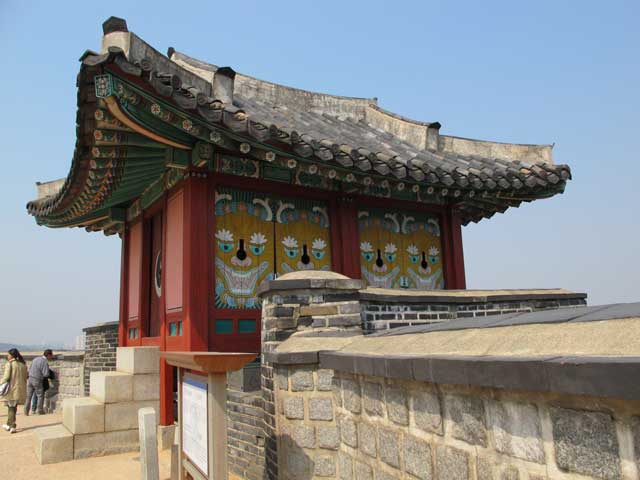

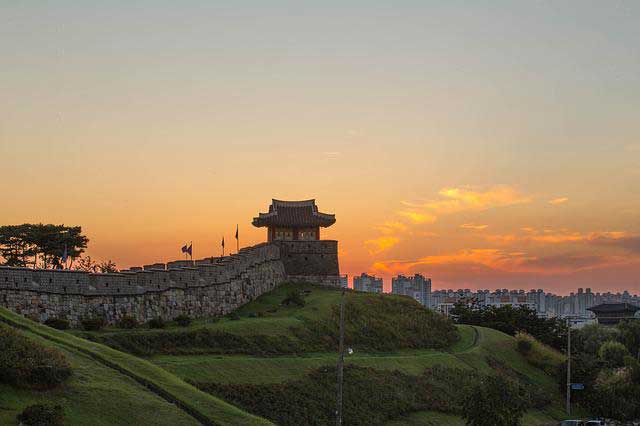
The area within the fortress walls contains the Hwaseong Haenggung - a temporary or detached palace for the king when he was visiting Suwon from the capital in Seoul. When the king was absent the buildings were used for administration purposes. Built in 1798, there are 22 buildings in the complex consisting of living quarters as well as offices, gates and a shrine.
Hwaseong Fortress
Tel: 031 251 4435
Access - Getting to Hwaseong Fortress
Take a Seoul subway Line 1 train to Suwon, from where Hwaseong Fortress is located to the north east and best reached by bus (#2, #7, #7-2, #8 & #13) or by taxi.
Suwon is also linked to the capital by train. The quickest is the KTX express train which takes just over 30 minutes from Seoul Station.
There are also buses to Suwon from Seoul, Busan, Daegu, Gwangju, Jeonju, Mokpo and Sokcho.

Book Hotel Accommodation in Seoul & Suwon
Suwon is close enough to the capital Seoul to see on a day-trip but if you do decide to stay longer the city has a good range of accommodation on offer.
Some recommendations include the four-star Ramada Plaza by Wyndham Suwon with three restaurants, a bar and located close to Suwon Stadium.
The three-star Ibis Ambassador Suwon is a 2-minute walk from Suwon City Hall Subway Station on the Bundang Line.
Korea Tourist Hotel is another three-star property offering good facilities close to Suwon City Hall.
See a complete listing of hotels in Suwon.
