
Korean Economy

According to some estimates, South Korea has the world's tenth largest economy.
It has a population of over 51 million, 35% of whom live in Seoul and its environs. The standard of living is close to that of Hong Kong, Taiwan and Singapore.
South Korea is close to Japan geographically and in economic style. Indeed the Japanese colonial period 1910-45 shaped the economic and industrial direction of the country. Any discussion of the economy cannot fail to mention the 'chaebol', the Korean equivalent of the big Japanese corporations.
The big names are Hyundai, Samsung, Lucky-Goldstar (LG), Daewoo, Sunkyong, Hanjin, Ssangyong, Kia, Hanhaw and Lotte. The chaebol and the government have had a close relationship for a long time, much in the same way as that of the big corporations and government in Japan. In South Korea, this has taken the form of cheap credit from government-controlled banks and tax breaks for the companies willing to pay bribes.
Most of the chaebol are concentrated in Seoul, Daegu and Busan (Pusan). Wealth is concentrated in South Korea in the hands of the chaebol. To give some idea of their size, in the early 1980's, the country's three biggest conglomerates accounted for more than a third of South Korea's entire Gross National Product (GNP). In addition, a 1970's study of top chaebol executives found that about 12 percent were closely related to the founders' families.
Another similarity with the Japanese model is that imports from abroad have been restrained by strict regulations and tariffs, while exporting has been aggressively promoted. These policies led Korea to become an Asian 'Tiger' economy, at least until the economic crisis in Asian economies in 1997/1998, from which it made a remarkable recovery.
Of course, this economic dip was not the first in Korea's recent history; the recovery from the Korean War (1950-52) was sluggish and a corrupt regime was ousted by the military. General (later, President) Park Chung-hee maintained control by means of rigging elections and human rights abuse. It was under his tutelage that the Korean economy took off. Priority was given, initially, to the exportation of low-cost goods, rather than the creation of homegrown industries making products designed to replace imports from overseas.
The downturn in the NASDAQ in the U.S. (falling during 2000 from a high of 5,000 to about half of that) has been reflected in the fortunes of the even worse performing KOSDAQ in Korea. In addition, by the end of the twentieth century the local currency (the won) had slipped in value to its 1988 level.
Nobel prize-winner President Kim Dae-jung of Korea and Japanese PM Mori set up a joint electronic commerce committee to help promote this area of business in Asia in the autumn of 2000. There are social and political hopes that the rapprochement between South and North Korea will unify the nation, but there are attendant economic fears concerning the cost of unification, given the German experience.
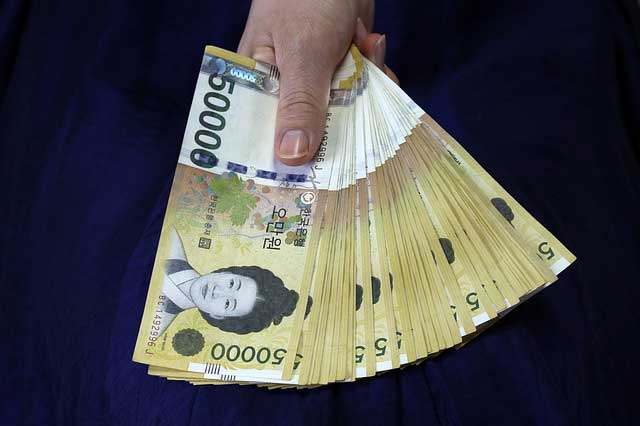
Contemporary Korean Economy
Nowadays, exports are of high technology products such as mobile phones, semiconductors, computer equipment and flat-screen TVs, as well as automobile manufacture and shipbuilding. It is in the first of these, the so-called New Economy, where Korea appears to be outrunning Japan in some areas.
As of August 2020, 96.5% of the South Korean population were Internet users, compared with 92.7% of the Japanese; with many more broadband subscribers in Korea. This prevalence of internet use has led to a booming e-commerce sector.
In 2010 South Korea experienced 6% growth far ahead of its neighbor Japan. By 2019 before the Covid-19 pandemic it had fallen to 2%, compared to 0.73% for the same year in Japan.
Korean companies such as Samsung, Hyundai and LG seem to have won their battles with such Japanese competitors as Sony and Matsushita, helped by the relative weakness of the Korean Won against the previously soaring value of the Japanese Yen. China is now South Korea's major import and export partner.
Possible economic problems on the horizon are Korea's rapidly ageing society and an over-dependence on exports to fuel growth.

2021-2026
South Korea’s economy from 2021 to 2026 was defined by a strong post-pandemic rebound, a subsequent period of high-interest-rate stagnation, and a powerful late-period acceleration driven by the global artificial intelligence (AI) boom. Following a sharp 4.1% GDP surge in 2021 as global lockdowns eased, growth slowed dramatically to 2.6% in 2022 and 1.4% in 2023. This downturn was triggered by aggressive central bank interest rate hikes aimed at fighting inflation, which cooling global tech demand and weakened the country's vital memory chip exports. While 2024 brought minor stabilization at 2.0% growth, 2025 saw a divergence where domestic consumption lagged due to heavy household debt, yet annual exports made history by crossing the $700 billion threshold for the first time.
By 2026, the economy accelerated sharply, driven by an explosive global upcycle in AI hardware and advanced semiconductors. Real GDP expanded by an impressive 3.4% year-on-year in the third quarter of 2026, putting full-year growth on track for its strongest performance in over a decade. However, this high-tech export vitality masks deep structural challenges. Moving forward, South Korea’s economic outlook remains deeply tied to the highly cyclical tech sector, while facing long-term headwinds from a rapidly aging workforce, record-low fertility rates, and stiff manufacturing competition from China.
South Korea Soft Power
South Korea's exports are not just limited to mobile phones and cars. Korean popular music (K-pop) and Korean TV dramas have become popular in many other Asian countries and even among the young in Europe and America. Korean food is also growing in popularity helped by Korean diasporas in the USA and UK. Tourism in South Korea is also on the increase with neighboring Japan and China supplying the bulk of incoming tourists often in the form of short 3-5 day package tours.
South Korea’s cultural soft power - collectively known as Hallyu (the Korean Wave) - has evolved into a massive global economic engine, generating roughly $19 billion in direct exports. While industrial heavyweights like semiconductors and automobiles drive the bulk of South Korea’s GDP, the creative sector delivers a highly lucrative "multiplier effect." Video games lead this cultural revenue at $7.83 billion, while K-pop and music exports have surged to $3.1 billion alongside a $1.6 billion broadcasting and movie sector. According to the Korea Creative Content Agency (KOCCA), this media presence operates as a premium marketing campaign for the nation: every $100 million increase in cultural exports triggers an additional $202 million in sales for related consumer goods.
This financial spillover creates a domestic economic ripple effect valued at over 48 trillion won (~$35 billion USD) by driving international demand for Korean lifestyle products and services. Global fandoms directly fuel record-breaking sales in the "K-Beauty" cosmetics industry, fashion apparel, and "K-Food" exports like instant ramen and kimchi, which frequently spike after appearing in popular media. Furthermore, this international exposure transforms digital streaming into tangible hospitality revenue, as millions of inbound tourists visit South Korea specifically to experience the food, concert venues, and filming locations they see on screen.
BTS and the hit series Squid Game triggered record-breaking financial swings for entertainment companies. For instance, the highly anticipated return of BTS from mandatory military service and their subsequent Arirang World Tour propelled their parent agency, HYBE (KRX: 352820), to a historic performance in the third quarter of 2026, delivering an all-time record 1.53 trillion won ($1.14 billion USD) in revenue. Meanwhile, the release of Squid Game seasons acts as a major catalyst for small-to-mid-cap Korean production agencies and talent firms, where stocks tied to the show's cast or production partners frequently experience sudden rallies of 35% or more. Beyond individual equities, Squid Game has even become a formal macroeconomic metaphor on Wall Street, with financial institutions using the show to describe the high-risk, high-volatility survival battle currently taking place within South Korea's retail-dominated KOSPI index.