
Fukuda Denshi Arena, Chiba Prefecture

Fukuda Denshi Arena (フクダ電子アリーナ) aka 'Fukuari' is one of the best football-only facilities in Japan. The stadium was built as an alternative venue to JEF United's former home ground, the unpopular Ichihara Seaside Stadium. It is one of several soccer stadiums within the greater Tokyo metropolitan area.
The ground was the first modern soccer stadium to be built in Japan following the building boom preceding the 2002 World Cup. Fukuari is the home ground of J.League club JEF United. The club were one of the original 10 J.League clubs.

History & Capacity
The 19,781 capacity stadium opened in October 2005 on what was a former Kawasaki Steel factory close to the ocean. The stadium is part of the larger Soga Sports Park and is located on the opposite side of Tokyo Bay from Haneda Airport.
There are four stands: North Side Stand (for home fans), South Side Stand (for away fans), Main Stand and Back Stand.
Stadium Overview
The city of Chiba owns the ground. SSP UNITED, a private enterprise, is the designated administrator. Fukuda Denshi is a manufacturer and seller of medical devices headquartered in Tokyo. They have owned the naming rights of the stadium ever since its opening.
As Chiba was considered one of the host cities of the 2002 FIFA World Cup, the ground was initially to have a capacity of over 50,000. However, with the bid having been rejected, building a large-scale arena no longer made much financial sense.
Nihon Sekkei took responsibility for the construction. The company also built the Ajinomoto Stadium in Tokyo.
Although the ground has 18,500 seats, it has never reached full capacity as the club prefers to have a buffer zone between the home and away fans. The club sells roughly 17,000 tickets on matchdays. A J2 fixture between JEF and local rivals Kashiwa Reysol in 2010 recorded its highest attendance to date, with 18,031 witnessing the action.
Stadium Stands
Unlike traditional British grounds, soccer stadiums in Japan tend to avoid having stand names. That is the case in Chiba, where the stands are called The Main Stand, The Back Stand, the home end Side Stand, and the away end Side Stand.
A variety of food options await fans in the restaurant area just outside the ticket booth.
The ground has eight restrooms. When purchasing merchandise, using a Suica or PASMO card may make the transaction easier.



Dimensions & Facilities
The stadium covers an area of 105 meters by 68 meters with a natural grass playing surface with no running track.
Stadium Miscellaneous
The first match held at the arena was against local rivals Kashiwa Reysol in an unofficial game. The first official match was a J1 fixture between JEF and Yokohama F. Marinos in October 2005. Yuki Abe opened the scoring in an entertaining 2-2 draw.
Wikipedia and other major websites suggest the JEF women's team use Fukuari and the nearby ZA Oripri Stadium in equal measure. But in reality, Fukuari is the preferred arena.
In 2009, the ground saw its first international fixture when Belgium faced Chile in the Kirin Cup. The attendance that day was 6,050.
The stadium has hosted two men's FIFA World Cup qualifiers. Japan faced Mongolia and Myanmar in 2021 on the road to Qatar. The Mongolia match was a humiliation ritual for the visitors (though it was registered by FIFA as a Mongolian home match), ending in a 0-14 drubbing. Prolific goalscorer Yuya Osako earned himself a hat-trick.

JEF United
JEF United Ichihara Chiba like many Japanese clubs began as a company team - Furukawa Electric Soccer Club. As JEF the team was an original member of the J.League in 1993 with Pierre Littbarski in its ranks. JEF struggled to remain competitive until Ivica Osim took over as manager in 2003. He stayed until 2006 when he took over the Japan national team from Zico after the 2006 World Cup. Osim was succeeded by his son Amar at JEF and later Josip Kuže and Alex Miller both had spells as coach until JEF were relegated to J2 in 2009. The club remains in the second tier as of 2025. They currently top the standings with a good opportunity to return to J1.

Early Club History
While the Furukawa Electric Soccer Club, the predecessor of JEF, was founded in 1946, its roots can be traced back to the early 1900s. Furukawa Electric's offices and factories were situated in Nikkō, Tochigi Prefecture. The workers' preferred sporting activity was ice hockey, but football was popular during the off-season. The soccer club was established in 1914. The popularity had spread to the Tokyo HQ, introducing the football division in the capital in the 1930s.
The club was forced to suspend its activities during World War II as many of its players were deployed to the frontlines.
The official records state the football division of Furukawa Electric was founded the year after the war's end. Frequent forfeits were a common issue since several squad members also had commitments in other sports, such as ice hockey and rugby. Their hometown was to be Nishi-ward in the city of Yokohama.

Ken Naganuma
Their fortunes changed when Ken Naganuma arrived at the club in 1955. Japanese football is deeply indebted to Naganuma for his contributions. Along with Yoshiaki Furukawa, the de facto founder of Cerezo Osaka, Naganuma was born and raised in Hiroshima. Both men survived the atomic bomb, but the trauma Naganuma witnessed in the following weeks changed him forever.
The devastation did not deter his love for the game, playing soccer with the ball he had sewn himself and clearing debris on muddy grounds with his friends. His talent was evident from his time at Hiroshima University High School, and together with Arawa Kimura and Taruya Keizo, he made a significant impact on youth football.
After graduating from Kansai Gakuin University in 1953, he switched to Chuo University, coming second in the All Japan University Championship as captain.
The 1954 FIFA World Cup in Switzerland was the first time Japan participated in qualifying. In the March snow at the Meiji Jingu Gaien Stadium against the Korea Republic, Naganuma became the first to score a goal for Japan in these games. Korea Republic won the match 5-1 and went on to qualify. He later admitted in a Tokyo Times article in 1969 that the focus for Japan was to be in the Olympics and did not grasp the significance of the World Cup.
In 1955, Naganuma joined Furukawa Electric, who were floundering in the second tier of the regional Kanto league. Mixed with ice hockey players, the club had no sense of professionalism. However, Furukawa's situation was typical, as pre-JSL Japanese football prioritized school football over the professional or adult-level competition. However, the corporation had a deeper understanding of sports compared to most teams and allowed the steely-eyed Naganuma to have free reign over the day-to-day duties. Having said that, the training regimen at Furukawa was a shambles. Practice started at 5 pm, after the shifts. Instead of improving their ball skills, all the players did was run around the outside track of the Imperial Palace for hours. It was not a recipe for success.
Naganuma became player-manager of the club in 1959 at age 28. Under his tutelage, Furukawa became the first corporation team to win the Emperor's Cup in 1960, overcoming Keio BRB in the final. A year later, he won the inaugural Footballer of the Year award, a title that is still going strong today.
The charisma Naganuma brought was something that the Japan national team wanted. He was appointed head coach in 1962 and caused a spike in popularity for football in the county when his team defeated Argentina 3-2 in the 1964 Tokyo Summer Olympics.

Furukawa Become Serious
Furukawa pounced on the chance to join the Japan Soccer League (JSL) when it was formed in 1965. The division continued until 1992 when it was rebranded to the J. League. Along with Furukawa, Mitsubishi Heavy Industries (the predecessor of Urawa Reds) and Hitachi (the predecessor of Kashiwa Reysol) dominated the JSL. The trio became known as the "Big Three of Marunouchi", as all of these corporations were headquartered in Marunouchi, central Tokyo.
Furukawa's role in shaping the early landscape of Japanese football remains undeniably significant. They are two-time winners of JSL, four-time winners of the Emperor's Cup, and claimed the JSL Cup on three occasions.
Furukawa showed their might in the transfer market when they brought back Yasuhiko Okudera from Germany in 1986. The contract was worth 40 million yen per annum, an unprecedented salary for a footballer in Japan. Okudera contributed to immediate success. Furukawa clinched the 1986 Asian Club Championship, the preceding tournament to the AFC Champions League. The club entered the tournament in the second round, placed in a group containing Selangor Football Club and Hap Kuan, a club from Macau (then a Portuguese colony).
The final round was also played in a group format, with all matches taking place in Riyadh. Furukawa made light work of their opponents. After overcoming Al-Hilal by a 4-3 scoreline, they saw off Al-Talaba Sports Club and Liaoning Football Club. It was the first time a Japanese team had become Asian champions.

New Season and New Identity
JEF started off the first J. League campaign (1993) away at the Hiroshima General Ground Main Stadium against Sanfrecce. After conceding a goal in the first minute, Pavel Řehák levelled the scoring. But it was ultimately Sanfrecce that had the last laugh, as Mitsuaki Kojima grabbed the winner eight minutes from time.
Before the start of the campaign, through the connections of general manager Okudera, JEF convinced the high-profile Pierre Littbarski to come to Japan. Thanks to his immense quality, the Chiba club earned their maiden league win on matchday two and thrashed Yokohama Marinos 5-0 early on. At one point, they even topped the standings. But a team relying on one man soon became predictable and ended the first stage in fifth place. In preparation for the second stage, they acquired striker Frank Ordenewitz from Koln but found it difficult to sustain any momentum. Chiba finished ninth in the second stage.
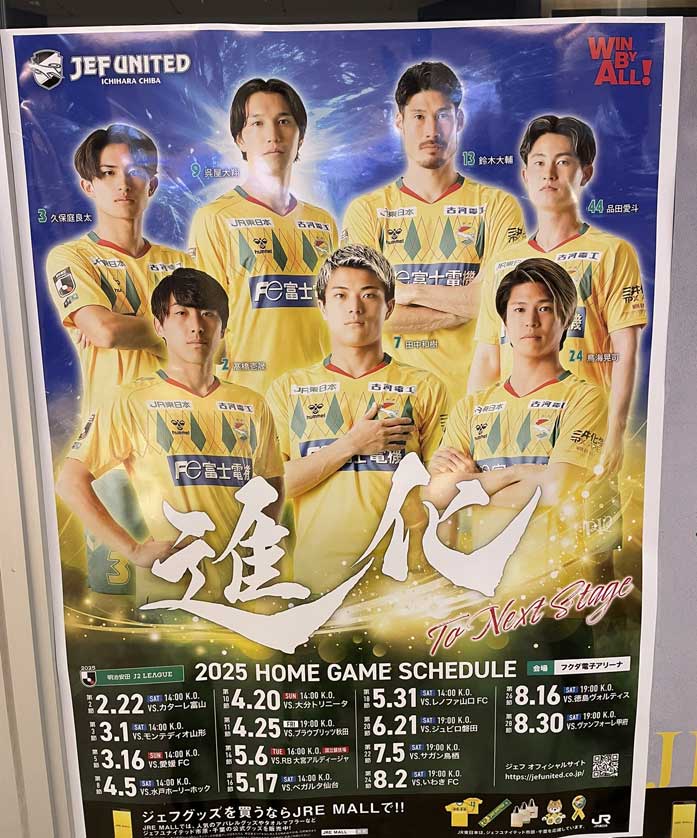
Turbulence in the 90s
JEF appointed Eijun Kiyokumo in the hopes of becoming a serious title challenger. But it spelled the end for Littbarski. The German clashed hard with the ex-defender and was frozen out of the squad by the end of the season. Montenegrin striker Nenad Maslovar joined, becoming the fulcrum of the attack almost instantly. Kiyokumo ordered a shuffling of the pack, letting Ordenewitz go, along with Řehák, František Mysliveček and, of course, Littbarski.
It did not mean JEF had become a team entirely composed of Japanese players. Kiyokumo bought Wynton Rufer and Goran Vasilijević for the 1995 season.
JEF were slowly becoming synonymous with mid-table mediocrity. GM Okudera was "promoted" to the position of manager. They strengthened with the signing of Ivan Hašek, who was exceptional for Czechoslovakia in Italia ‘90. Future Borussia Dortmund and PSV Eindhoven manager Peter Bosz was also recruited.
Dutchman Jan Versleijen became the first foreign manager of the club in 1997. Rade Bogdanović moved from Pohang Steelers that year but didn't last a season. Former Ajax and Feyenoord midfielder Arnold Scholten joined in the mid-season transfer window, featuring in just under fifty games before departing for FC Den Bosch.
In 1999, Gert Engels was in the hot seat, but his record in the first stage was appalling, resulting in the sack. Nicolae Zamfir from România dragged JEF out of the relegation zone, securing survival on the final day.

2000s and Osim
As the league entered the millennium, the power balance between the clubs had become clearer. Verdy Kawasaki were glamorous in the beginning, Marinos were stable, which cannot be said for their cross-town rivals Flügels, and Jubilo and Antlers were dominant. As for JEF, they often produced subpar results, interspersed with exciting cup runs.
The league started to take JEF more seriously with the arrival of Ivica Osim in 2003. Osim's life stories are well-documented in the Japanese press. Born in Sarajevo, he was more or less destitute, similar to the other kids in the neighbourhood. In a world devoid of entertainment, football had naturally become a joyous escape. He rolled his socks into a ball-like shape and played the game endlessly.
At age 18, Osim was talented enough to be scouted by Fudbalski Klub Željezničar. Although gifted in football, he could have pursued a more cerebral career as a mathematician. He had graduated from the University of Sarajevo with a bachelor's degree in mathematics. Yet, Osim chose football. His first taste of Japan came at the 1964 Summer Olympics in Tokyo. He scored four goals throughout the tournament.
He gained more big-game experience in a Yugoslavia shirt when he was picked for UEFA Euro 1968 in Italy. He started in the semi-final against world champions England at the Stadio Artemio Franchi in Florence. Yugoslavia emerged victorious, the mercurial Dragan Džajić scoring the winner. But it was the end of the road for Osim, who sustained an injury and missed the final against the hosts. Gli Azzurri won the competition after a reply.
From 1970 to 1978, Osim bounced around French clubs. His first foray into the French league was with Racing Club de Strasbourg, the club where he finished his career. He also featured for CS Sedan and Valenciennes.
His transformation into management was instantaneous, returning to Željezničar in 1978. After an eight-year stint, he took charge of the Yugoslavia national team, overseeing the 1990 FIFA World Cup. The country was a talent factory at the time, containing the likes of Dragan Stojković, Robert Prosinečki, Safet Susic and Dejan Savićević. While Alen Boksic, Robert Jarni, and Davor Suker were all waiting for their chances from the substitute's bench. Yugoslavia reached the quarter-finals but were eliminated by Argentina on penalties in a nervy encounter.
Yugoslavia qualified for Euro 1992 but Osim resigned less than a month before the tournament. He felt he was not fit to represent a war-torn country, knowing his family in Sarajevo faced bombardment. UEFA disqualified Plavi (The Blues), replacing them with Denmark. Football fans around the world know what followed next.
Osim took over Sturm Graz as coach in 1994. He won two Austrian Bundesliga titles and appeared in three UEFA Champions League campaigns. His standout season in Europe was the 2000-01 campaign, when Graz finished top of a group that included Glasgow Rangers, Monaco, and Galatasaray. The Austrians were placed in a tough group in the second stage, having to face Valencia, Manchester United and Panathinaikos. Although Graz collected three points against Panathinaikos home and away, they were overwhelmed by the other two giants. The gulf in quality was particularly on show on matchday five where Graz were outclassed by Valencia 0-5 in a home tie at the Liebenauer Stadium.

Osim in Japan
At Chiba, Osim made a few innovative changes. He appointed 21-year-old Yuki Abe captain and gave many youngsters opportunities. It was because he demanded his players to be willing runners all over the field. "Running football" or 「走るサッカー」, as it was called, was to become the motto. He developed an interesting dynamic with striker Seiichiro Maki, planting new ideas he had never encountered before. On a 2006 program shown on NHK, Maki revealed he had asked Osim why his daily training regimen was only 90 minutes long. Osim replied to Maki to give his absolute all in those 90 minutes because it includes everything to improve his game as a striker. It was a radical approach in Japan, where supplemental practices after training were the norm. JEF finished third in the overall 2003 J1 standings, equalling their 2001 season record.
Before the opening of the 2005 campaign, Chiba signed Ilian Stoyanov from Levski Sofia, while Jubilo pillaged JEF by taking Takayuki Chano and Shinji Murai. This was the first time the two-stage format was scrapped. Chiba closed the season in fourth, but the real drama awaited in the J.League Cup. After seeing off Jubilo in the quarters, they headed to the Urawa Komaba Stadium to play Urawa Reds at the semi-final stage. Maki bagged two goals in the first 17 minutes of play, and though Robson Ponte pulled one back for the hosts, Gabriel Popescu killed the game with his goal in the second half. The second leg was played at the ZA Oripri Stadium. The game finished 2-2 after Yuki Abe equalised three minutes from time.
The final at the old National Stadium against Gamba Osaka was tense and ultimately decided by a penalty shootout. Osim, who suffered nightmares in penalty shootouts, notably in Italia ‘90, withdrew to the changing rooms. But Chiba were deadly from the spot, winning a trophy for the first time after their identity change.
Amar Arrives
JEF repeated the feat in 2006, dispatching a talented but underwhelming Kashima Antlers 2-0 in the final. Abe was once again on the score sheet, along with Koki Mizuno, who soon moved to Glasgow Celtic. But that League Cup victory took place under the leadership of Amar Osim, the son of Ivica. Ivica Osim had been hand-picked by the JFA mid-season after sacking Zico following a dismal showing in the 2006 World Cup. Ahead of the 2007 campaign, Chiba lost talisman Abe to Urawa Reds.

The 2008 Season
2008 was a memorable campaign but it also showed signs of the dark times ahead. JEF had lost competitiveness in the transfer window, losing Yuto Sato to Kyoto Sanga, and Hiroki Mizumoto to Gamba. Their new Croatian coach Josip Kuže was relieved of his duties less than midway through the season. Former Liverpool assistant Alex Miller was brought in as his replacement. Chiba earned their first win of the campaign on the day Miller arrived, defeating Kyoto 1-0. Chiba floundered for the rest of the campaign and were teetering on the precipice on the final day. At the time, J1 featured two automatic relegation spots, while the team finishing 16th would face a playoff. Consadole Sapporo had already secured relegation, leaving one of Júbilo, Tokyo Verdy, or JEF to join them in the drop. JEF were odds on to go down as they were two points adrift, meaning they had to win their game versus FC Tokyo and hoped Jubilo and Verdy would lose.
FC Tokyo took the lead at Fukuari before half-time when Caboré‘s bullet header flew past Ryo Kushino. Rising starlet Yuto Nagatomo made it 2-0 ten minutes after the restart, leaving JEF on the brink. "The Miracle of Fukuari", as it would be called, started in the 74th minute when Tatsunori Arai halved the deficit. At this point, JEF had become unstoppable. Tatsuya Tanizawa equalised soon after, and the stadium was in raptures when Reinaldo made it 3-2. Tanizawa got his brace and put a gloss on the scoreline. But the job was only half done, as they needed results in Tokyo and Shizuoka to go their way. Incredibly, Kawasaki Frontale defeated Verdy by a 2-0 score, while Omiya Ardija edged Jubilo 1-0 at the Yamaha Stadium. JEF were safe outright, but Verdy were in misery. Jubilo avoided relegation via the playoffs.
Relegation
The miraculous escape proved to be a false dawn. At the halfway point of 2009, the struggling JEF axed Miller, hiring Atsuhiko Ejiri in his place. Relegation was confirmed on matchday 31 against Kawasaki. It was a historic moment for a club that had never been relegated to a division below since the Furukawa Electric days.

Life in J2
JEF had an opportunity to escape the abyss of the J2 via the playoffs. Chiba dominated Yokohama FC 4-0 in the semis at the Nippatsu Mitsuzawa Kyūgijō. They took on Oita Trinita at the National Stadium, with JEF being the bookie's favourites before kickoff. Takenori Hayashi scored an unexpected late winner, denying the Kanto club promotion..
For the 2017 playoffs, Chiba were going into the semi-final game against Nagoya Grampus at the Paloma Mizuho Stadium as underdogs. As Nagoya had finished above Chiba in the regular season, Chiba were in a win-or-bust situation. Although ex-Celta Vigo and Rayo Vallecano striker Joaquín Larrivey shined, Robin Simovic grabbed the headlines with a hat trick as Nagoya overpowered the visitors 4-2.
Chiba's dismal record in the playoffs continued in the 2023 edition, losing to Tokyo Verdy 1-2 at the Ajinomoto Stadium.
As of early June 2025, Chiba top the J2 standings but RB Omiya Ardija are hot on their heels. Unlike JEF, Omiya can rely on foreign investment thanks to the Red Bull takeover in September 2024.
JEF United Ichihara Chiba Ladies
The women's section of JEF was formed in 1992. In 2008, JEF Ladies won promotion to the Women's Empowerment Professional Football League, commonly referred to as WE League.
JEF acquired forward player Karina Maruyama from Philadelphia Independence in 2010. She was part of the triumphant Japanese squad for the 2011 FIFA Women's World Cup in Germany. This victory is still one of the proudest achievements in Japanese football, symbolising the resilience of the Japanese populace despite the setback of the Tōhoku earthquake that occurred months prior.
JEF Ladies have won one League Cup, earning the trophy in 2017. They are yet to be champions of the WE League.

Club Icons (Littbarski and Stoyanov)
When one thinks of past JEF greats, Pierre Littbarski springs to mind. A World Cup winner with West Germany in Italia '90, the winger is a certified 1. FC Köln legend.
In 1993, Littbarski joined JEF from Köln with a contract signed as the second-highest-paid player in the league. He revealed later that he had rejected a deal with Urawa Reds the previous year. Although he had never been to Japan before the transfer, he was teammates with Yasuhiko Okudera at Köln. Okudera is a forgotten Japanese superstar whose only senior club in Japan was Furukawa Electric, the predecessor to JEF.
Nicknamed "Litti", the player appeared in commercials often and was one of the most prominent figures in the Japanese game, crowded with other famous names. During the 1993 season, Littbarski was the only World Cup winner to represent the league. He scored his first goal in Japan with a technically astute free-kick against Verdy Kawasaki. By the time JEF entered the second stage, Littbarski had become jaded, and the reliance on him during the attacking phase had increased. He recorded a memorable goal straight from a corner at the Sapporo Atsubetsu Park Stadium in August, also against Verdy Kawasaki.
However, the next season proved to be a disappointment. The goals dried up and clashed with manager Eijun Kiyokumo. He was let go at the end of the 1994 campaign, simultaneously announcing his retirement from professional football.
Littbarski was back on the pitch in 1996, this time for Brummell Sendai, the predecessor to Vegalta Sendai. Brummell at this stage were a Japan Football League outfit, therefore it is difficult to argue he played professional football in Tohoku.
His managerial career has been nomadic. His first job was at Yokohama FC, where he has had two spells. After taking charge of Sydney FC, he returned to Japan as head coach of Avispa Fukuoka in 2007. After departing FC Vaduz of Liechtenstein in 2010, he has not managed a team since.
The West Berlin native is a fluent Japanese speaker.
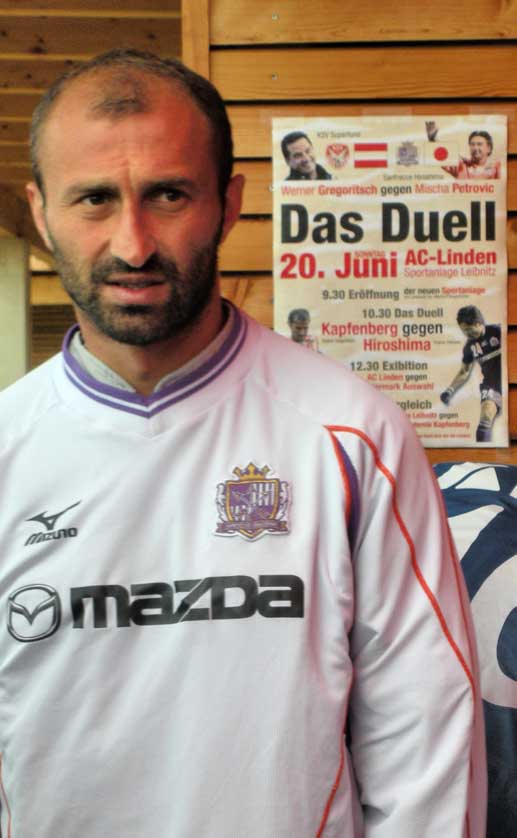
For a more recent audience, Ilian Stoyanov may be a memorable inclusion. The Bulgarian defender featured in two UEFA Euro 2004 matches in Portugal. The J. League was his first foray outside of his homeland, spending five years at Levski Sofia before moving to the Far East. He joined Chiba in March 2005, making his debut against Nagoya Grampus. He grabbed his first goal against Omiya Ardija in July. Ivica Osim deployed him as a sweeper, and he quickly became a solid presence at the back. His first season culminated gloriously, beating Gamba Osaka in the Nabisco Cup final.
His spell in Chiba ended suddenly in 2007 when he publicly criticised Amar Osim in June. He was taken out of the squad immediately and was shown the door by the end of July.
Several Japanese clubs were chasing the Bulgarian, and a month later, he signed with Sanfrecce Hiroshima. Despite often playing out of position and suffering relegation, Stoyanov stayed put, showing his gratitude to Sanfrecce for picking him up mid-season.
After a long hiatus, Stoyanov was back in the fold for Bulgaria, featuring regularly in 2010 World Cup qualification. Bulgaria failed to qualify from Group 8, which contained Italy and the Republic of Ireland.
A transitioning Sanfrecce deemed Stoyanov unfit for purpose and was shipped off to Fagiano Okayama. The J2 outfit was his last club before hanging up his boots.
Post-retirement, Stoyanov has settled in the Hiroshima/Yamaguchi area. From 2012 to 2014, he operated a restaurant in Hiroshima and founded Dios Hiroshima, a local futsal team. In 2014, he moved to Shunan in Yamaguchi prefecture and started a football school, the FC Stoyanov Football Academy.
He was part of the coaching staff at Kamatamare Sanuki for two months in 2021. He is now a football coach at Aioi Gakuin High School in Hyogo prefecture.
Club Miscellaneous
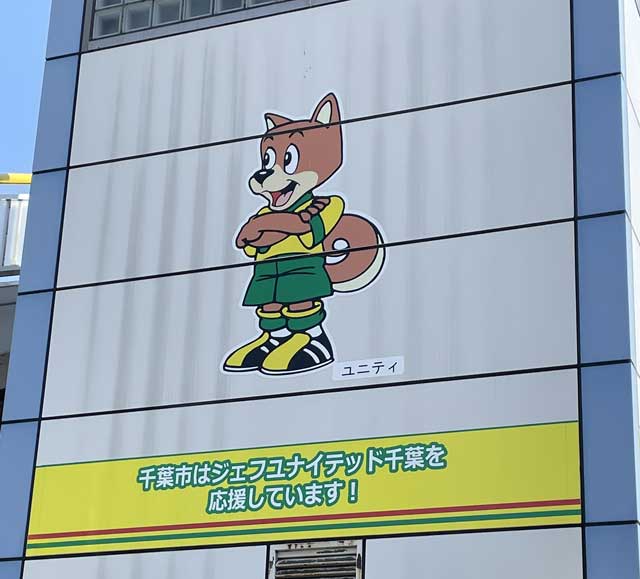
JEF have adopted the Akita dog breed on their logo. They have three mascots, Jeffy, Unity and Mina. Jeffy and Unity are brothers.
Major Honours
League:
Best placed finish in J1: Third in 2001, 2003
Cup:
J League Cup winners: Twice in 2005, 2006
Accessibility
The ground has a total of 110 wheelchair spaces, sectioned into nine areas.
JEF Chiba provides discounts to supporters with disabilities but the process can be slightly tiresome. The official website recommends filling the Discount Ticket Application Form, with the template available in PDF format. Another option is to contact the fan club bureau, with the phone number being 0570-064-325. To contact them via email, use the fanclub@jefunited.co.jp handle. The bureau is open from 11 a.m. until 6 p.m. on weekdays.
Access - Getting There
Train & Bus
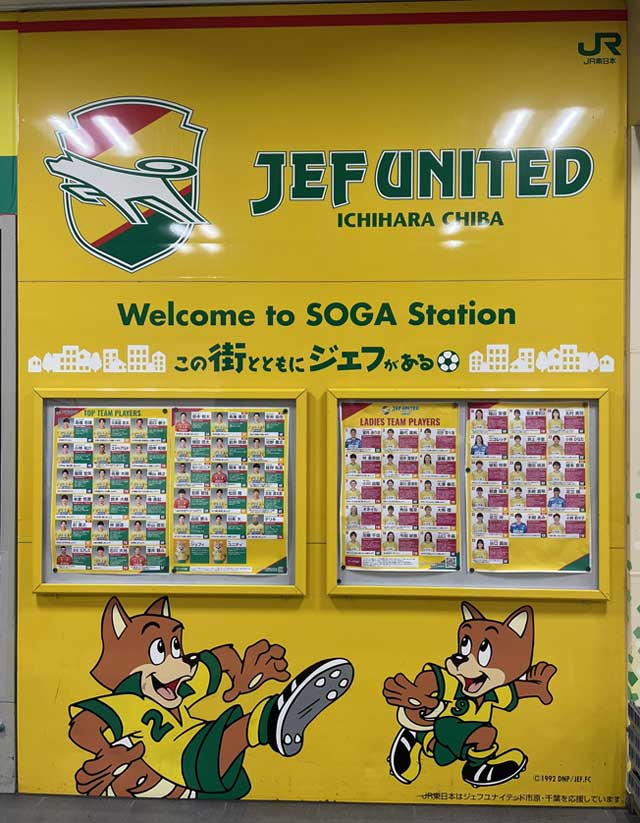
The most common way to access the stadium is through Soga Station on JR East. Since JR's relationship with JEF is inseparable, the station is decorated in yellow and green, along with other memorabilia, to show their support. Look out for the West Exit. After walking straight for about seven minutes, you will come across a footbridge. The footbridge makes the journey somewhat arduous. The path afterwards is rather straightforward. Fukuda Denshi Arena is an approximately 10 to 15-minute walk from JR Soga Station.
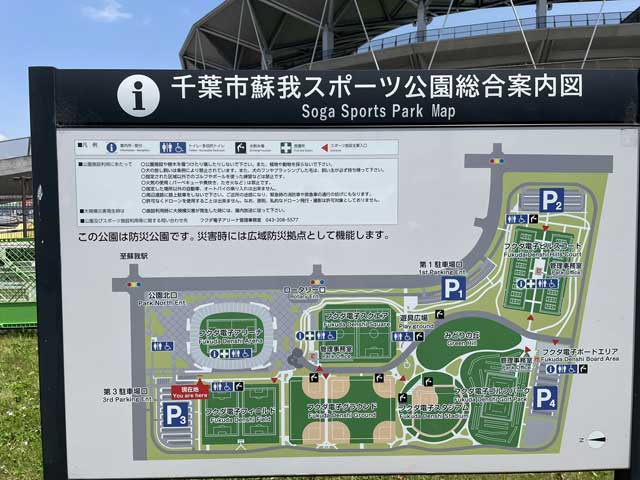
The stadium is part of the Chiba City Soga Sports Park complex. The park has four large parking spaces, with the largest having space for 469 vehicles. It is open from 8.30 a.m. until 9.30 p.m. The maximum cost for one average-sized vehicle is 700 yen per day. Please be aware that automobiles cannot be parked without a reservation.
Cyclists and motorcycle users can park their vehicles for free.
JR Soga Station is just over 40 minutes by train from Tokyo Station on the Keiyo Line.
1-20 Kawasaki-cho, Chuo-ku, Chiba 260-0935
Tel: 043 208 5577
Nearby Hotels
Chiba Prefecture has a range of hotel and guesthouse options ranging from luxury 5-star properties to more affordable business hotels.
If you do wish to stay close to the stadium try the 3-star Hotel Route-Inn Chiba Hamano or alternatively, the pleasant, three-star Hotel Livemax Chiba Soga Station.

Nearby Sights
Tokyo Disneyland
Tokyo Disneyland is 40 minutes away by train in Maihama.
Chiba Shrine
Chiba Shrine is an historic Shinto Shrine that was previously a Buddhist temple in Chiba city.

J.League Stadiums
Tosu Stadium (Ekimae Real Estate Stadium)
Toyota Stadium Aichi Prefecture

©Soccerphile.com
Buy tickets for soccer matches around the world