
Eating Dog In Korea
This article does not condone the practice of eating dog in South Korea and other countries. It is an account from around 20 years ago of one such dog market in the capital of South Korea, Seoul, and is meant to inform of the situation. The market featured in the article, Moran Market, officially shutdown in 2018 following years of declining sales. According to Wikipedia, in 2019, fewer than 100 restaurants served dog meat in Seoul (out of over 520,000 restaurants in the greater Seoul area), as the numbers have continued to decline each year. Some restaurants are reporting drops in consumption of 20-30% per year. In 2017-2019 all major dog meat markets had shut down across South Korea, mainly due to falling demand. In January 2024 South Korea's parliament passed a bill banning the breeding and slaughter of dogs for consumption.
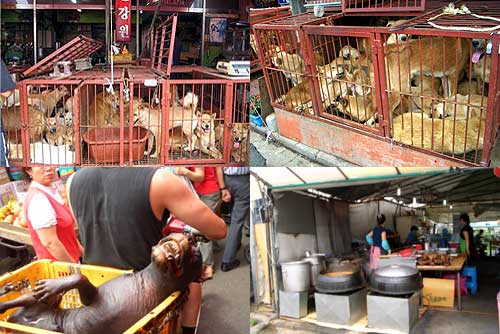
Exit Moran Station on the Bundang Line of the Seoul Subway system on any day of the month ending with the numbers 4 or 9 for the farmer's market day.
Moran market is an open air one, and just as well. The overpowering smell of singed dog fur permeates the air, mingling with the more familiar scent of unsinged dog fur coming from the narrow cages where the still living animals await the edge of the hatchet and the blast of the blowtorch.
The chunks of dog meat visible on chopping blocks make for grotesque snapshots.
While white tourists may represent a culture that horrifies Hindus and mortifies Muslims with global emporiums hawking beef and pork, outraged Westerners with cameras have shown enough snaps to the wrong people for Korean dog meat merchants to idly stand by. Even just stopping to look will elicit cries of "Move on, move on!"
If you've made it this far, you should have left any qualms at home.
Yet it is not just dogs. Goats, rabbits, and even cats are lined up for the same fate although one with a slight twist for the cats, which are boiled down in pressure cookers to produce a tonic known as goyangi soju, believed to cure rheumatism and neuralgia, among other complaints.
The tents you will see a little past the market are where you can taste the produce. The fickleness of fate is fully felt here, however, as more fortunate breeds, such as poodles, sit coiffured and pampered in pet vendors' stalls within earshot of the doomed. My most worrying mental snapshot of the half-day I spent at Moran market is of a little dog on a leash tethered to the iron bars of a cage full of red-pelted dogs awaiting slaughter.
History
Dog meat is a delicacy with a history, not only in Korea but also in the sophisticated cuisine of China and Vietnam. Eating dogs is by no means uncommon in other parts of the world. Amply documented examples of it exist even in France, Germany and Switzerland.
The Law
Korean law is a potentially tricky, but in practice, largely ignored, area when it comes to the topic of dog meat.
In 1984, the processing of dog meat was declared illegal, at least in Seoul, if not in the rest of Korea. Various half-hearted attempts have been made by the government to discourage the trade, but these tend to coincide only with the expected arrival of large numbers of foreigners to the country, such as at the 1988 Olympics and the 2002 World Cup.
The taste for dog meat was a time-honored and integral part of Korean culinary culture and, as such, proved, until relatively recently, impervious to any official pronouncements against it. Dog farms and dog meat merchants, although often operating outside the law, were - largely for that reason - not inspected by the health authorities. The market and the nation's numerous dog meat restaurants therefore operated in the gray zone between what the statutes said and what the authorities did not do.
Without a knowledge of Korean, dog meat restaurants can be difficult to find, so if you're ready to sate your curiosity, find a Korean guide.
If you have go it alone, however, Kim Ki-ho Boshingtang Jeonmunjeom (Kim Ki-ho's Dog Stew Specialty House) in Bucheon, a town west of Seoul, and easily accessible by subway, was recommended in days gone by.
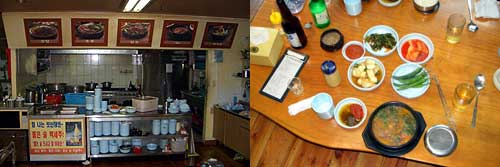
Boshintang
Korea's most famous dog dish is boshintang, a soup whose prime ingredient is dog meat, and with a reputation for endowing the diner with added sexual vigor. The chunks of meat in the soup taste vaguely like mutton. The flavor is enhanced by the spices you will find next to your bowl: deulgge (coarse-ground perilla seed) mixed with sesame oil and kojujang (red pepper paste).
Other dishes include suyuk, or boiled dog meat, often eaten with lightly boiled leeks, and muchim, boiled meat mixed with a variety of spices.
A version of this article appeared in the Kansai Time Out magazine.
The views expressed in this article are solely those of the author.