World Cup 2018 Group H Preview
GROUP H
Sean O'Conor
Poland
Coach: Adam Nawalka
Formation: 4-2-3-1
FIFA World Ranking: 8th
Best World Cup: 3rd in 1974 and 1982
 |
 |
Poland Kit 1
|
Poland Kit 2
|
Poland v Senegal 19 June; Sochi
Poland v Colombia 24 June; Moscow (Spartak)
Poland v Japan 28 June; Kazan
Poland make a happy return to the finals after missing out on the last two. Their coach Adam Nawalka played for their classic 1970's team alongside the great Zbigniew Boniek, Kazimierz Deyna and Grzegorz Lato.
It is also the first time for one of the world's best forwards, Robert Lewandowski to play at a World Cup.
Aged 29, the elegant Bayern Munich striker has an impressive 52 goals in 93 outings for his country and was the top scorer in the UEFA World Cup qualifying groups with 16 strikes in ten games, one more than Cristiano Ronaldo.
Inevitably the Polish game is based around Lewandowski, who will roam alone up front with a trident of three behind him - Napoli's Piotr Zielinksi in the middle and two wide raiders - Hull's Kamil Grosicki and one of Lokomotiv Moscow's Maciej Rybus or Wolfsburg's Jakub Blaszczykowski, the man with the most unspellable surname in the finals.
Blaszczykowski was their best player at Euro 2016 but has been beset by injury this season. A number of the squad have had niggles this season or a lack of first-team football, which is a worry as they are one of the oldest groups in the tournament.
Poland will counter-attack when possible with hard running with the aim of feeding their star striker. Nawalka prefers a four man defence but recently experimented in friendlies with a 3-4-3 and 3-5-2 and insists his team must be flexible before every game.
Monaco's Kamil Glik will be key in holding the defence together but Lewandowski apart all eyes will be on Zielinksi's midfield mind. The 24 year-old is at his third Italian club and has enjoyed a great season with Napoli.
He has the faith of his manager as the fulcrum of the side and his transfer value could rise after the tournament even higher than the £58 million Napoli slapped on him earlier this year when Liverpool called.
2018 has seen Poland register reasonable friendly scores: A poor 0-1 loss to Nigeria was followed by a 3-2 win over South Korea, a 2-2 draw with Chile and a 4-0 win over Lithuania.
It is easy to forget Poland are the seeds in Group H - ranked eight places above Colombia going into the finals. They were ranked sixth in the world at the time of the draw so on paper they should be heading the into knockout stages without too much bother.
Yet this will be no cakewalk and the Poles have their hardest two games first - Senegal in Moscow almost feels like a cup final, before taking on the Colombians in Kazan.
Whatever their chances, Polska will be cheered on by thousands of fans who will happily make the hop across the Belarusian or Ukrainian border and on towards Russia.
Senegal
Coach: Aliou Cissé
Formation: 4-3-3
FIFA World Ranking: 27th
Best World Cup: Quarter finals 2002
 |
 |
Senegal Kit 1
|
Senegal Kit 2
|
Senegal v Poland 19 June; Moscow (Spartak)
Senegal v Japan 24 June; Ekatarinburg
Senegal v Colombia 28 June; Samara
The Lions of Teranga are back at the World Cup for the first time since their legendary year of 2002 when they beat the holders France in their first game.
That was their first participation in the finals which ended with a narrow 1-0 loss to Turkey in the quarter finals.
Aliou Cissé, a player with Birmingham City, Portsmouth and PSG, is the manager charged with getting out of Group H. As captain of their 2002 team he allows the nation to tap into those memories.
His squad is all European-based with the exception of reserve goalkeeper Khalim Ndiaye who plays in Guinea.
Seven of them are based in England, most notably Liverpool striker Sadio Mane, who was recently rumoured to be on his way to Real Madrid having lost to them in the Champions League final.
Mane is really their star player - very strong, fast and with good close control in the African tradition, a proven terroriser of defences. Supplying him with the bullets is Keita Balde, the 23 year-old Monaco winger who came through Barcelona's La Masia academy and spent five productive years with Lazio.
After just a season in the principality, the Spanish-born Keita has a reasonable return of eight goals in 23 matches.
Other attacking options include another 23 year-old M'Baye Niang, who came through the French youth ranks before switching allegiances last year, Rennes striker Diafra Sahko and Bursaspor's Moussa Sow.
Centre back Khalidou Koulibaly has been earning rave reviews at Napoli for the past four years and is a complete defender.
They qualified with ease, topping African Group D by five points after four wins and two draws but their lack of big tournament experience is a factor which could work either way.
A quarter-final finish in last year's African Cup of Nations showed promise. They were only eliminated on penalties by Cameroon having beaten World Cup qualifiers Tunisia 2-0 in the group stage.
In 2018, draws with Bosnia, Luxembourg and Uzbekistan did little to suggest Senegal will ruffle any feathers in Russia, but they revved up earlier this month and showed more teeth in a narrow 2-1 loss to Croatia in Osijek and a 2-0 win over South Korea in Austria.
Cissé has experimented with several players in defence and midfield as well as formations ranging from 5-4-1 and 4-5-1 to 4-3-3. He likes Senegal to attack powerfully up the flanks, knowing they have a real striker of quality waiting in the area.
In qualifying they made good use of set pieces too, crashing the box with large bodies.
He is a well respected coach as well as a disciplinarian, another African football tradition, so will demand his side work hard and not lose their heads in their opening match against Poland, conscious that the hardest test comes last against Colombia.
Colombia
Coach: Jose Pekerman
Formation: 4-2-3-1
FIFA World Ranking: 16th
Best World Cup: Quarter Final 2014
 |
 |
Colombia Kit 1 |
Colombia Kit 2 |
Colombia v Japan 19 June; Saransk
Colombia v Poland 24 June; Kazan
Colombia v Senegal; 28 June; Samara
Los Cafeteros (the coffee-makers) are back for another brew after a sip of success in 2014.
In their first World Cup since 1998, Colombia played some attractive passing football to win their group, their dancing celebrations and joie de vivre capturing the spirit of the tournament and many global fans. FIFA awarded the team the Fair Play Trophy at the end.
James Rodriguez emerged as a star having scored the goal of the tournament against Uruguay, one of six which won him the Golden Boot. The young attacking midfielder then won a dream move to Real Madrid.
But his and his nation's World Cup ended in tears as they lost 2-1 to Brazil in the last eight, with James in particular the victim of unpunished rotation fouling by the hosts.
Still, it had been a wonderful ride and so unexpected considering they had lost their talisman Radamel Falcao to injury before the finals.
Falcao is in Russia for his first and probably last World Cup finals aged 32, but his very presence inspires the team. He is their skipper and Colombia's all-time top goalscorer.
The 2014 dream did not last long however. 2015's Copa America was a damp squib for Los Cafeteros with some really dreary performances and only a 1-0 win over a poor Brazil providing some consolation for the World Cup exit.
The 2016 Copa America (centenary edition) was an improvement as Colombia came third but fourth place and qualification for Russia was only assured in the final game.
Three draws and a defeat in their final four games saw the side limp over the line. While they had risen as high as third in the FIFA World Rankings by the end of 2014, by the time of the draw they were 13th and missed out on a seeding.
That said, Japan, Poland and Senegal feels like a lucky draw and it will be a major surprise if Colombia do not finish first.
With Argentine coach Jose Pekerman still in charge and much of the same personnel, Colombia are trying to prolong the spirit of 2014.
David Ospina is still the man between the sticks. Despite on-off employment with Arsenal he remains agile and a mainstay of the team.
Davinson Sanchez has emerged via Ajax and Tottenham as a cultured centre back and will line up alongside Jerry Mina, recently signed by Barcelona. Right back Santiago Arias is doing great things at PSV and the left back should be Girona's Johan Mohica, who is a useful crosser.
They play with two defensive midfielders - Carlos Sanchez and Abel Aguilar, but the emphasis of the side is offensive - Colombia like to attack with three or four runners supporting Falcao up front.
James is obviously the fulcrum - pulling the strings in the hole between attack and midfield. Juventus' Juan Cuadrado will man the right flank, an incisive runner who made the most assists in Brazil 2014.
On the left Pekerman can choose from a number of speedy raiders but may opt for Sevilla's Luis Muriel, who scored against France in Paris in a memorable 3-2 victory.
There are good options on the bench too - Miguel Borja is an imposing alternative No.9 to Falcao, Brighton's Jose Izquierdo loves running at defences and Juan Quintero and Mateus Uribe are quality midfielders.
Defender Cristian Zapata of Milan and Villareal striker Carlos Bacca bring much experience.
Combative midfielder Edwin Cardona and pint-sized dribbler Yimmi Chara did not make the cut to some surprise but Pekerman has enough options for a successful run in Russia.
The manager is well-respected by his players and the nation, who granted him honorary citizenship after the last World Cup. Theirs is also a happy and united squad, whose televised dances are proof of their strong friendship.
Colombia are erratic and inconsistent under Pekerman however. A 2-1 loss away to South Korea late last year was followed by a 4-0 win in China, a mightily impressive 3-2 win over France in Paris and 0-0 draws with Australia and Egypt.
In those last two games however they did not lack attacking endeavour or shots on goal. Colombia will hopefully be as entertaining in Russia as they were in Brazil.
Japan
Coach: Akira Nishino
Formation: 4-2-3-1
FIFA World Ranking: 61st
Best World Cup: 2nd Round 2002, 2010
 |
 |
Japan Kit 1
|
Japan Kit 2
|
Japan v Colombia 19 June; Saransk
Japan v Senegal 24 June; Ekatarinburg
Japan v Poland 28 June; Volgograd
In 2010 Japan beat Denmark 3-1 with such ease to make the Round of 16, it seemed to confirm they and Asian soccer were here to stay.
Then they lost on penalties to Paraguay in the second round and were out. In 2014 their best result was a 0-0 draw with Greece as they finished bottom of their group. The Denmark match was a false dawn.
While happy to have qualified for 2018, topping Asian group B a point ahead of Saudi Arabia and Australia, Japan must have swallowed hard when Colombia's name came out of the hat. Samurai Blue were thrashed 4-1 by the South Americans in Brazil 2014.

2018 began with a 1-1 draw with modest Mali before a trio of defeats - 2-1 to Ukraine, 2-0 to Ghana and 2-0 to Switzerland, leaving Japan demoralised. A 4-2 win over Paraguay in Innsbruck a week before the World Cup restored some confidence.
It has not been plain sailing off-field either - Japan is on its third coach since the end of the last World Cup.
Vahid Hallihodzic was fired in April after a tumultuous reign which saw ongoing disputes with the players, press and association and a failed attempt to instill a more direct and physical playing style, criticising the traditional possession-based Japanese game.
The Bosnian bizarrely dropped the team's top stars - Shinsuke Honda, Shinji Kagawa and Shinji Okazaki in 2015 and fielded a second division player instead. Last month he announced he was suing the JFA (for 1 yen) following his firing.
Akira Nishino, the JFA technical director, took over despite more than two years out of the coaching game and with precious little time to prepare for the World Cup.
The old guard has been recalled and the squad has a distinctly experienced feel - only two of the 23 are aged under 25 and both of those - goalkeeper Kosuke Nakamura and defender Naomichi Ueda, have only three caps apiece.
Expect a return to the same skilful short passing in which the Far East nations specialise. That is Japan's biggest strength and weakness as there is no realistic plan B.
4-3-3 is their favoured shape with Werder Bremen striker Yuya Osako the No.9, Honda to his right and Genki Haraguchi of Fortuna Dusseldorf on the left.
Honda has the experience and the skills - dribbling, free kicks, passing and playmaking, but at 32 and now playing in Mexico with Pachuca is perhaps past his peak. His five years with CSKA Moscow will make him feel at home.
Leicester attacker Shinji Okazaki, whose strong running can trouble most defences, is another forward option. He is one of two Premier League players in the squad - the other being Southampton defender Maya Yoshida.
Behind the strikers is Borussia Dortmund's Shinji Kagawa, a well-known face in Europe but inconsistent for his country.
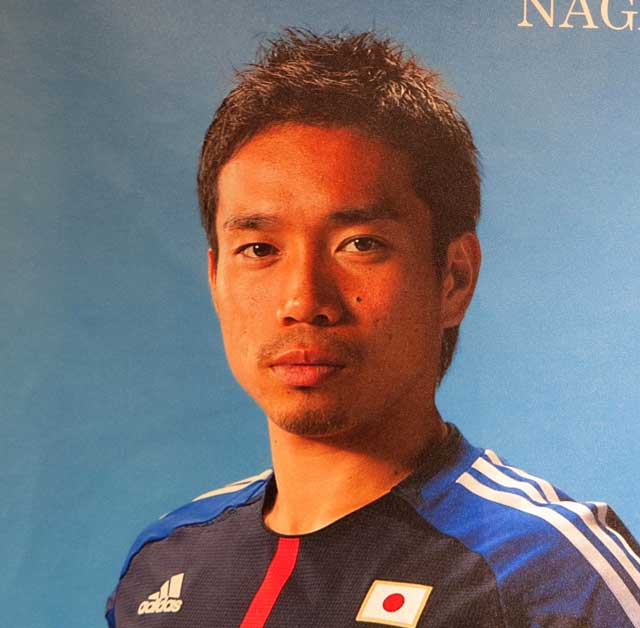
Another Germany-based player anchors the midfield - Eintracht Frankfurt's Makoto Hasebe is a stalwart at 34 alongside Galatasaray's Yuto Nagamoto or Urawa's Tomoaki Makino.
Japan have been through some turmoil over managers and arrive without the necessary evolution since the last World Cup.
Despite that they remain a positive side who play attractive football with the emphasis on attack and are happy to shoot from distance.
That said it is hard to see them getting out of the group with such a porous defence.