
ICONS IN THE SAND: WHY QATAR IS ON A QUEST TO IMPRESS IN 2022
Sean O'Conor
The World Cup is much more than a football tournament.
Apart from the Olympic Games, it is the only regular cultural event with a truly global reach, as the television viewing figures confirm.
The last one, Russia 2018, was watched by a whopping 3.57 billion people, more than half the planet's population aged over four years.
It was in 1966 that huge global TV viewing figures of the tournament in England first convinced major sponsors to get on board and turned FIFA into a money-making machine. The World Cup would never be the same again.
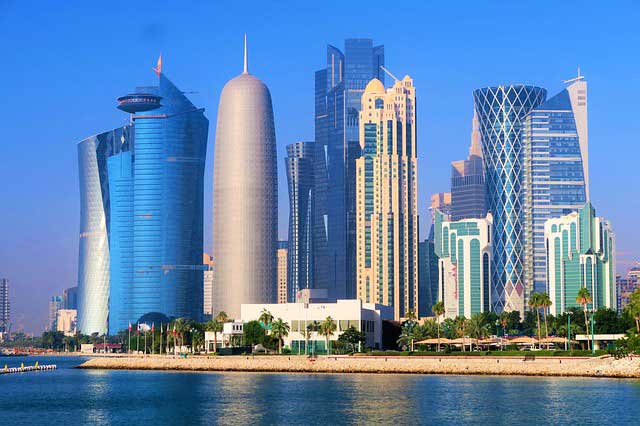
Staging FIFA's big show now entails a four-year long charm offensive to butter the globe up, selling the host nation as a tourist destination as well as a sporting venue and forging an international brand with distinctive symbols, slogans and other identifiers.
While there has been an official poster going back to the 1930 event in Uruguay, a logo has been a part of the World Cup since Switzerland 1954 and a mascot since England hosted it in '66.
The first official song dates from Chile in 1962 and official anthems from France '98. Official FIFA World Cup computer games began with Mexico '86 and are now inseparable from the brand too.
Another integral part of the World Cup package are the venues. It is not enough now to moderately refurbish existing stadia or design forgettably functional-looking arenas.
A World Cup demands at least one signature stadium, an architectural statement to the world that something really special is going on.
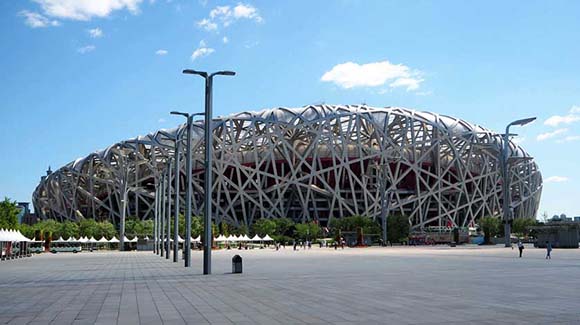
2008 Olympic Games
Blame Beijing. For the 2008 Olympic Games the Chinese capital wowed the world with their Bird's Nest stadium, an arena so distinctive it became the textbook example of that now much-overused prefix 'iconic'.
It really was a triumph, transcending sport and establishing global admiration and name recognition.
A collaboration of designers, engineers and builders produced a great work of art which is a national tourist attraction to this day.
It also made a confident political announcement that China had set sail with aplomb in the early years of this century to overtake the United States as the world's dominant economy and culture.
The Bird's Nest could not be topped.
When London 2012 ditched a similarly ambitious stadium plan for a more functional and modest design it looked like the bar had been raised too high by the Chinese. The 19th century's imperial lion had been muted by the 21st century's top dog.

World Cup 2010 South Africa
Yet the first World Cup since the Beijing Olympics produced a pair of iconic football stadia: Johannesburg's Soccer City and the Cape Town Stadium. The former, shaped like a traditional South African culinary vessel, was a wonderfully detailed building as well as a metaphor - the rainbow nation a giant melting pot.
The latter was a simple thing of beauty, its shimmering elegance in perfect harmony with the coastal sunshine and natural beauty of South Africa's most popular destination.

World Cup 2014 Brazil
Four years later, Brazil went back to functionality on the whole with a dozen refurbished but fairly unimaginative stadia.
Manaus' Arena do Amazonas was a neat little number however with an inflatable look perhaps derived from the distinctive 'car tyre' of Munich's Allianz Arena.
The most eye-catching of the grounds however was Natal's Arena das Dunas, apparently inspired by the city's coastal sand dunes but also redolent of a giant hermit crab which had crawled in from the nearby Atlantic.
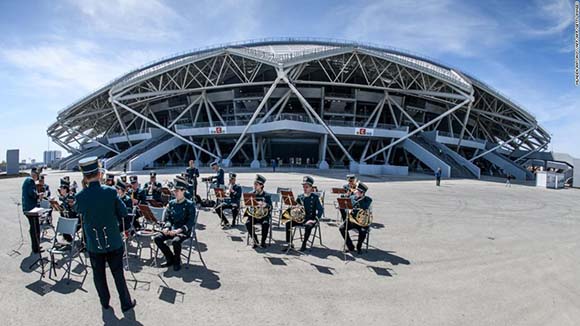
World Cup 2018 Russia
For Russia 2018, Samara's Cosmos Arena was the most memorable of the venues, a wonderful homage to the proud history of Soviet space exploration and which would not have looked out of place in a sci-fi movie.
Samara achieved exactly what 'iconic' stadia should aim to do - accelerate beyond functionality into the realm of art and other fields.
Previous World Cups have thrown down the gauntlet. So what will the icon for Qatar 2022 be?

World Cup 2022 Qatar
The Al-Janoub arena in Al-Wakrah is the early frontrunner, from the stable of the late Zaha Hadid, who designed London 2012's Aquatic Centre.
Its expressive exterior has all the flowing dynamics synonymous with the Iraqi-born starchitect, who died in 2016.
Hadid was also known for her playful sense of humour and some have interpreted nods to female pudenda in the roofline, a feminist joke amid a largely male tournament in a decidedly patriarchal country.
Maybe she did have the last laugh but her firm insists the design comes from upturned hulls of Arab dhows - traditional pearl fishing boats.
Al-Janoub has an external aspect alternatively mollusc-like or recalling internal musculature, a uniquely organic language for a genre normally functional or inspired by fortresses.
Like the cosmos arena it would also sit happily with sci-fi and its space age form will make it the must-visit stadium for groundhoppers in Qatar, proof perhaps that great architecture can be judged by the numbers of sightseers it attracts.
While its stunning façade will wow the public, the Al-Janoub's interior seems tame and a little claustrophobic by comparison, although if as it claims it can reduce the heat in the stands to a cool 18C, all will be forgiven.
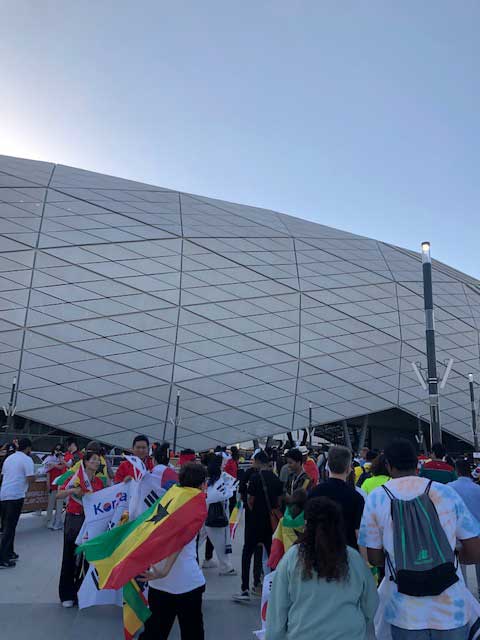
But there is some competition in the 2022 aesthetic league table from Doha's Education City Stadium, whose shell, inspired by chiselled diamonds, looks like a giant pixelation, a wonderfully apt metaphor for this digital age.
The last eye-catching arena Qatar is presenting is the one selected to host the final - the 80,000-seat Lusail Stadium from Foster & Partners, architects of Wembley Stadium.
The Lusail is also inspired by the local heritage - in this case traditionally woven Arab wicker baskets and like England's home field is a uniform design without a true focal point, a valid criticism when comparing the new Wembley to old twin towers, which were indeed iconic.
Most of the Qatari venues will downsize after the tournament or be recycled elsewhere, which not only ticks the green boxes but serves as confirmation of the World Cup as an ephemeral show with the arena the once to be worn party dresses.
Qatar has been a largely unpopular choice of host since the off, the most controversial in fact since FIFA awarded the 1978 tournament to the military junta of Argentina.
But a smoothly-run tournament with fantastic football two years from now can soothe the rancour. Iconic visual reminders in the form of stunning stadia popping up in the desert can help Qatar's counter-narrative and so the 2022 hosts are flashing the credit card to make the most amazing venues.
They will all seem very modern and dressed to impress, but there is nothing new about flamboyant sports arenas.
Rome's Colosseum, the mother of stadia design, still towers imperiously over the city, its multiple storey an overwhelming confirmation of the empire's continental prowess and love of entertainment.
In 1936, the Nazis made a bombastic claim that they were the true inheritors of the grandeur that was Rome in the austere classicism of Berlin's Olympiastadion. But they dropped the baton less than ten years later as their thousand-year empire lay in ruins with millions dead.
Werner March's Berlin design is still pretty much intact today with its classically-inspired columns, statues and colonnades a slightly uncomfortable monument to an evil regime but equally with the benefit of hindsight a reassurance of its failure.
The only overtly Nazi symbol remains the swastika on the large cast-iron bell which now squats upon the grass outside, permanently cracked following a British air-raid.
36 years after Jesse Owens, Germany's successful and confident reinvention was commemorated by another outstanding Olympic Stadium, this time in Munich. With its flying Bedouin tent-style transparent roof, the former home of Bayern & 1860 remains an outlier in stadia design, spectacular and futuristic to this day.
In football history, it also earns a place as the graveyard of total football's tangerine dream, when the Netherlands lost the 1974 World Cup final there to West Germany.
Iconic World Cup stadia built specifically for the event really began with Italia '90. At the time Italian football ruled the roost as Serie A hoovered up the world's best players and made a clean sweep of the three European trophies in its hosting year.

The Stadio Giuseppe Meazza, better known as San Siro, was rebuilt for that tournament into a genuine showstopper. Its eleven spiral walkways, four porous corner towers and giant roof girders make it a stadium unlike any other and instantly recognised.
As much the work of engineer Leo Finzi as building designers Giancarlo Ragazzi and Enrico Hoffer, it marked the merging of the two disciplines in the dominant zeitgeist of hi-tech architecture.
It came as a shock to the soul therefore to hear last year that Inter and Milan were planning a smaller and much less iconic replacement for their world-famous home field but all that glitters is not gold. For some years the stadium has been in need of refurbishment and the lack of natural light has caused endless problems for the grass.
Also at Italia '90, Turin gave us the Stadio Delle Alpi, a cutting-edge design from local architects Studio Hutter, whose cavernous interior and cantilevered crown of a roof made an equally aesthetic impact but whose dismal sightlines and long distance from the city centre made for such a poor atmosphere there were few mourners when it was demolished in 2009.
Bari's Stadio San Nicola, also from the class of Italia '90, was another glittering venue but like Turin had the fatal flaw of a running track around the pitch, which for football is a dealbreaker. For all its starchitect signature from Renzo Piano, the San Nicola now hosts a third division club.
While Italy's stadia were on a different planet to England's in 1990, their sheen has definitely worn off. Perhaps spectacular showpiece arenas for a month-long jamboree are just colossal frou-frous set to flicker briefly but then crumble and rust once the circus has left town.

Qatar's like any other host's run this risk too. Al Khor's Al-Bayt stadium for 2022 even looks like a circus tent from a distance, although of course it is built to represent a traditional Bedouin desert home.
While World Cup stadia tend to get reused by clubs, former Olympic venues can notoriously leave a trail of debt.
Montreal 1976 famously took 30 years to break even, while most recently Rio 2016's now decrepit Olympic Park was closed this year on public health grounds.
Nevertheless, memory favours the happier times. The need to impress the globe still overrides any consideration of what to do with these sporting cathedrals once the party is over. For that reason Qatar is pulling out all the stops for 2022 with its eight arenas.
The official 2022 tournament logo even resembles a figure eight, amongst other things.
One thing is for sure. World Cup stadia are now about so much more than venues for elite football matches.
Qatar knows this more than anyone right now.
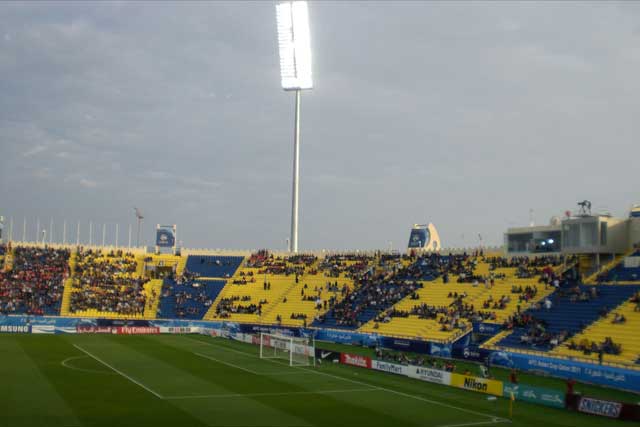
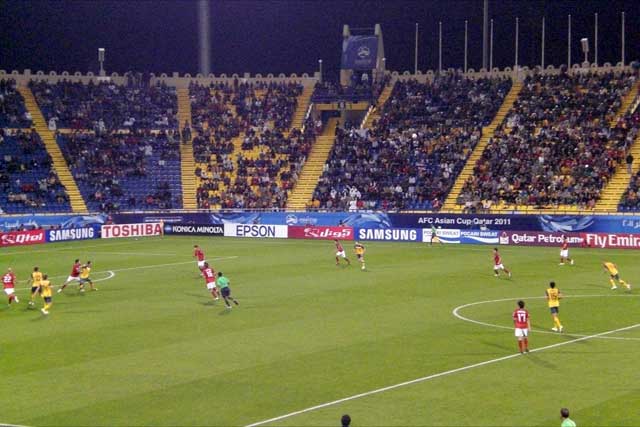
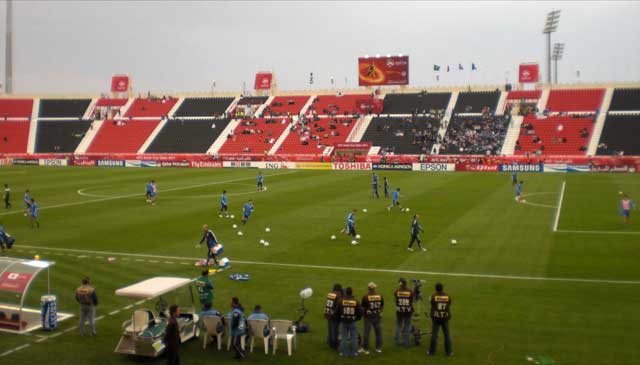
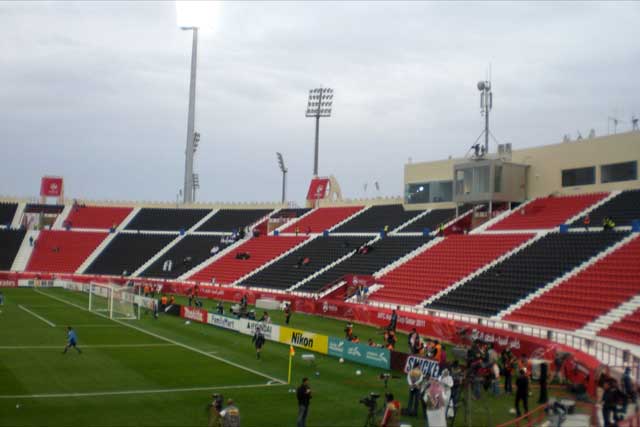
© Sean O'Conor & Soccerphile
World Cup 2022 Qatar
World Cup Korea/Japan 2002 - relive all the best from a great tournament.
World Cup Germany 2006 - all the action from one of the best World Cups ever.
World Cup South Africa 2010 - the first ever World Cup tournament in Africa.