
Who can win the World Cup? The major challenges facing the 48 teams heading to North America
By Marc Fox
Spain may be the bookmakers' favourites to win this year's World Cup but the first tournament co-hosted by three countries spread across a vast geography could throw up a host of non-football-related challenges for any of the contenders.
As if the fact that Fifa has added 16 more teams than in Qatar 2022 wasn't testing enough, meaning 48 teams will compete in the World Cup for the first time, semi-finalists will play eight matches - up from seven after the inclusion of an additional round-of-32 knockout phase.
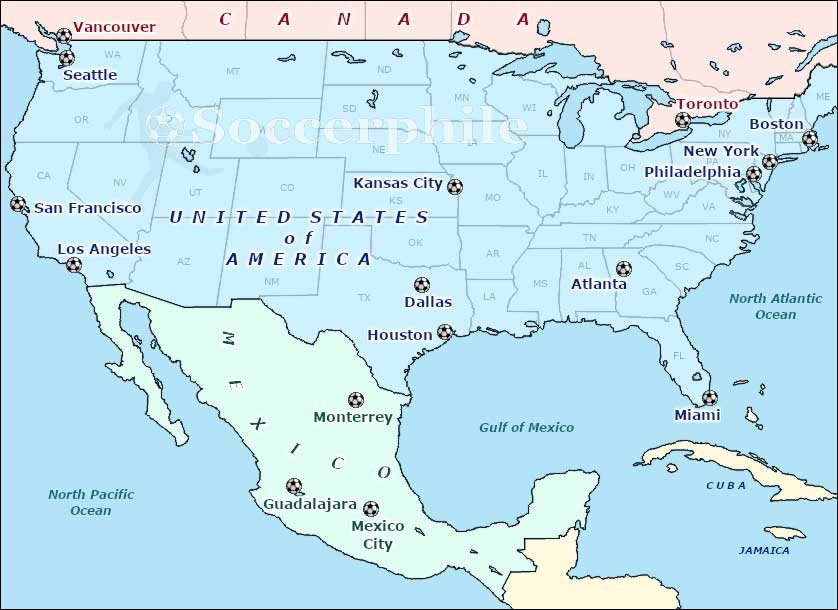
Throw into the mix that the most northerly host city, Vancouver, is approximately 4,000 km from the most southerly host city, Mexico City, as well as the impact of heat stress, long-haul travel and the workload placed on tired players and you can see the extent of the logistical challenges facing this year's finalists.
Indeed, according to an article in Sports Medicine, although "World Cups present one or more environmental challenges to players' health and performance, including, heat, altitude, air pollution and allergens, and travel … never has one tournament presented such a combination of extreme environmental factors as the Men's 2026 FIFA World Cup" [1].
While player unavailability due to injury and tiredness after long domestic seasons will be causing managers headaches, it is these off-field factors that might prove to be the greatest barriers of all.
Extreme heat
This year marks the World Cup's return to North America after 32 years and Fifa has already pre-empted the draining effects of the summer climate on players by mandating that three-minute hydration breaks be used in each half of all games.
However, according to the same article in Sports Medicine, "[e]xtreme heat is expected in 14 out of the 16 host cities" during the World Cup finals in June and July [1], while a Nature paper published in 2024 stated that "ten out of all sixteen 2026 FIFA World Cup venues are at very high risk of experiencing severe heat stress conditions" [2]. The authors of that paper state that "unacceptable heat stress will occur in the afternoon in stadiums located in the southern regions of the United States (Arlington, Houston) and in Monterrey (Mexico)" [2].
This could affect many participants, fans, workers and others.
For example, the group match between England and Croatia will kick off at 4 pm local time in Dallas, while two round-of-32 matches and one round-of-16 match also have early afternoon kick-off times.
A 2025 paper in the International Journal of Biometeorology claims that "[a]lmost 90% of host locations experience [temperatures] in an average year exceeding thresholds beyond which some football governing bodies would recommend cancellation or postponement, with over 50% of host locations exceeding these levels more than half the time in a hot year" [3].
Another article in the same respected journal explores the concerns about thermal stress on supporters attending matches in the hottest venues [4]. The authors note that while "[s]hifting games later in the day promotes the health and safety of athletes and spectators once a match has begun … later start times due to thermal stress have the potential to extend heat exposure to fans outside of stadiums."
They list, among the potential problems, the effects on fans needing to walk long distances to stadiums, on those participating in gatherings before matches (e.g., Fifa fan festivals) and on those without tickets kept outside grounds, for whom "heat illness risks from thermal stress are heightened" [1], including heat stroke, heat exhaustion, hyperthermia and exertional heat illness.
Travel
Given that the tournament is played in 16 cities located across North America, it has been calculated that "up to 19 time zones may be crossed to reach team base camps" [1], negatively affecting players' mental and physical health and, ultimately, their in-game performance.
While some teams, including 2022 runners-up France, have relatively straightforward travel arrangements for the group stage (all three matches are in northeastern states of the United States), England will have to switch from playing their opener in Dallas to their subsequent games in Boston and New York.
But that's nothing compared with the schedule facing Bosnia and Herzegovina, who have to cover more than 5,000 km with group matches in Toronto, Los Angeles and Seattle. And, remarkably, Algeria must travel between Kansas City and San Francisco for their group games.
Such time zone-crossing long-haul travel causes jet lag and body clock issues for players as well as hampers their recovery - and it can even lead to performance drop-offs between matches and a heightened risk of injury.
However, the potentially unfair advantages for teams with less travel in tight groups ought also to be flagged, while the environmental and financial ramifications of such an arduous cross-country expedition are clear.
In a paper titled "FIFA World Cups: An Own Goal Against Sustainability", Gilles Paché's analysis highlights "a troubling trend where profit and logistics consistently overshadow environmental sustainability in elite football" [5].
Load
Semi-finalists will play eight matches over a possible 39 days - up from seven matches across 29 days in Qatar after the inclusion of the round-of-32 knockout phase.
The expanded tournament length means that the showpiece World Cup final at MetLife Stadium in New Jersey isn't scheduled until 19th July, after the time when many club sides will have already returned to pre-season training.
When you factor in that Fifa's mandatory release period for players will begin on May 25th - just a day after the end of the Premier League season in England - the potential for both physical and mental fatigue among players becomes apparent.
The importance of data analytics and sports science for managing not only performance but also, and increasingly, recovery between travel and matches is rising.
Tailored adjustments to recovery strategies, including personalised sleep schedules, and precisely planned training loads can help sustain performance as well as mitigate the risk of injury.
But the mental welfare of players is also under the spotlight.
According to an article published in Football Studies earlier this year, "Growing evidence also highlights the impact of cognitive fatigue as a factor contributing to tactical errors and reduced performance in the final stages of matches" [6]. The authors add that "[t]his underscores the need to manage mental freshness with the same rigor as physical readiness."
Meeting this challenge falls to the ever-growing bands of coaching staff that accompany national teams to international tournaments.
In such a complex set of environmental conditions as will be found in this year's World Cup, the importance of these coaches operating in the background is increasing rapidly and could prove decisive for successful teams.
Such a combination of extreme heat, long-distance travel and high-intensity workload with short recovery time will provide an unprecedented challenge to participating teams.
This year's World Cup, according to Fifa President Gianni Infantino, will be much more than just a sporting event. "It's simply the greatest event that humanity, that mankind, has ever seen and will ever see," he claimed at the draw in December [7].
What is true is that the victors will have to overcome a unique combination of environmental factors to lift the trophy and mark them as perhaps the greatest World Cup winners of all.
Notes
[1] Esh, C. J., Carter, S., Bougault, V. et al. The 2026 Men's FIFA Football World Cup: Evidence-based guidelines to protect player health and performance from environmental challenges. Sports Med (2026). https://doi.org/10.1007/s40279-026-02398-4
[2] Lindner-Cendrowska, K., Leziak, K., Bröde, P., Fiala, D., Konefał, M. Prospective heat stress risk assessment for professional soccer players in the context of the 2026 FIFA World Cup. Sci Rep 14, 26976 (2024). https://doi.org/10.1038/s41598-024-77540-1
[3] Mullan, D., Barr, I., Brannigan, N. et al. Extreme heat risk and the potential implications for the scheduling of football matches at the 2026 FIFA World Cup. Int J Biometeorol 69, 753-763 (2025). https://doi.org/10.1007/s00484-025-02852-4
[4] Craig, C., Karabas, I. Forecasting thermal stress for sports tourists at the 2026 FIFA World Cup. Int J Biometeorol 68, 2731-2742 (2024). https://doi.org/10.1007/s00484-024-02785-4
[5] Paché, G. FIFA World Cups: An own goal against sustainability. IUP J Manag Res 23, 51-58. (2024)
[6] Chmura, P., Praça, G. M., Oliva-Lozano, J. M. et al. FIFA World Cup 2026: Performance under pressure-Scientific guidelines for success. Football Studies 1, 100008 (2026). https://doi.org/10.1016/j.footst.2025.100008
World Cup Venue Cities
2026 World Cup Venue Cities Guide - All 16 venues in USA, Mexico and Canada.
Buy tickets for soccer matches around the world